Korean Grammar, Explained Simply
Korean grammar without complicated terminology — start with the example, understand the feeling, then check yourself with a quiz.
Each page tackles one pattern — a particle, an ending, a connector — the way you'd actually run into it in a sentence, not as an abstract rule to memorize. Look up the exact piece of grammar that confused you (a specific ending or particle you just heard), not the whole list at once.
33 pages · 28 with a short video · 1 with our own photos or handwriting
Most read by learners
All 33 pages
What Is 받침 (Batchim)? The Final Consonant, Explained
받침 (batchim) is the consonant that sits at the bottom of a Korean syllable block — and the reason particle choices like 은/는 and 이/가 change.
▶ Short video
Korean Causative and Passive Verbs: 먹이다 vs 먹히다
Korean turns 먹다 into 먹이다 (feed) and 먹히다 (be eaten) with tiny suffixes. Learn the causative and passive suffixes -이/히/리/기- and the common verb pairs.
▶ Short video
들 (deul): How Korean Plurals Actually Work
들 (deul) is the Korean plural marker, but it's optional: add it for 'more than one' (친구 → 친구들), skip it after numbers or when context is clear. Rules, examples.
▶ Short video
What Does 도 Mean in Korean?
도 (do) is the Korean particle for 'also' and 'too' — including how it replaces 은/는/이/가/을/를 in a sentence.
▶ Short video
-았/었으면 좋겠다: Wishing and Hoping in Korean
Say 'I wish…' or 'I hope…' in Korean with -았/었으면 좋겠다: why the past tense is there, how it differs from -고 싶다, and the softer -(으)면 좋겠다.
▶ Short video
-(으)ㄹ 것 같다: How to Guess, Hedge, and Sound Polite in Korean
-(으)ㄹ 것 같다 means 'I think / it seems / probably' — Korean's all-purpose hedge. Learn its three tense forms and why Koreans use it even for what they know.
▶ Short video
What Does 을/를 Mean in Korean?
을/를 (eul/reul) is the Korean particle that marks the object of a verb — with real examples, common mistakes, and a quiz.
▶ Short video
What Does 은/는 Mean in Korean?
은/는 (eun/neun) is the Korean topic marker, explained with simple examples — no complicated grammar terminology needed.
▶ Short video
Korean Future Tense: -(으)ㄹ 거예요 Explained
Learn Korean future tense with -(으)ㄹ 거예요 — the standard 'will/going to' pattern — with the batchim rule, examples, and common mistakes.
What Does -고 싶다 Mean? Saying 'I Want To' in Korean
Learn the Korean pattern -고 싶다 for 'want to' — verb stem + 고 싶어요 — with examples, the -고 싶어하다 twist for other people, and a quiz.
What Does 하다 Mean? The Most Useful Verb in Korean
Learn what 하다 (hada, 'to do') means in Korean and how it combines with nouns to create hundreds of verbs — study, work, love, exercise, and more.
▶ Short video
What Does 하고/와/과 Mean? "And" in Korean
하고, 와/과 and 그리고 are Korean's three main ways to say 'and' — the first two connect nouns, 그리고 connects sentences — with the batchim rule.
▶ Short video
How Do You Say "You" in Korean? (Usually, You Don't)
Learn why Korean avoids a direct 'you' — 너 is only for close or younger people, and 당신 can sound confrontational — and what Koreans say instead.
▶ Short video
What Does 이/가 Mean in Korean?
이/가 (i/ga) is the Korean particle that identifies or emphasizes the subject — with real examples and a quiz.
▶ Short video
Korean Indirect Speech: -다고, -냐고, -자고, -(으)라고 Explained
Say 'she said that…', 'he asked whether…' or 'they told me to…' in Korean with the four reported-speech endings -다고, -냐고, -자고 and -(으)라고, with examples.
▶ Short video
What Does 있다/없다 Mean in Korean?
있다 (issda) and 없다 (eopda) mean 'exist/have' and its opposite in Korean — used for possession, location, and abstract things like time.
▶ Short video
What Does -지 않다 Mean? Korean Negation Explained
Learn the Korean -지 않다 negation pattern — the long form of 안 — with examples, how it compares to 안/못, and when each is more natural.
존댓말 Endings Reference Guide
A quick-reference chart of Korean polite (존댓말) sentence endings — statements, questions, and commands — pulling together patterns from across this site.
▶ Short video
Korean Counters: 개, 명, 마리 and Friends
Korean says 'coffee two cups' (커피 두 잔), not 'two coffees.' The core counters (개 things, 명 people, 마리 animals, 잔 drinks), the word order, and a quiz.
▶ Short video
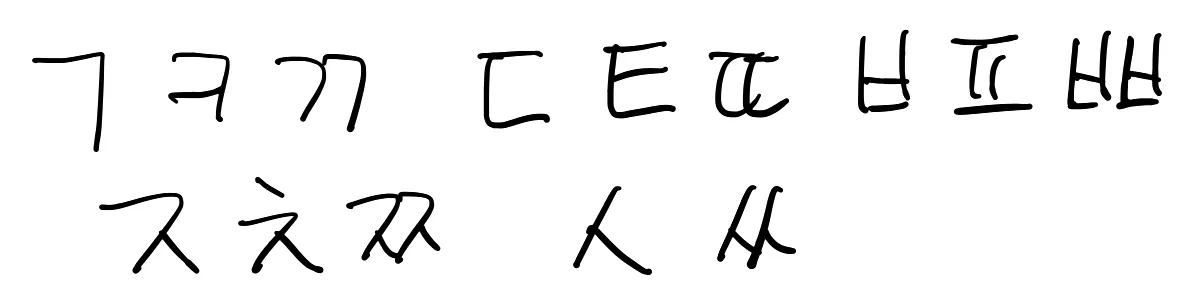
Korean Double Consonants (ㄲㄸㅃㅆㅉ), Explained
Korea's 5 tensed double consonants, 쌍자음 (ssangjaeum) — ㄲ ㄸ ㅃ ㅆ ㅉ: how they're pronounced with extra tension, with minimal pairs like 사다 vs 싸다.
▶ Short video✍️ Handwriting
Korean Honorific Verbs: 드시다, 계시다, 주무시다
Learn Korean's irregular honorific verbs — 드시다 (eat), 계시다 (be/exist), 주무시다 (sleep) — that replace ordinary verbs entirely when speaking about elders.
▶ Short video
Korean Particles: The Complete Beginner Guide
A complete map of Korean particles for beginners — 은/는, 이/가, 을/를, 에, 에서, 도, 만 — what each one does and how they work together in a sentence.
▶ Short video
Korean Question Words: 누구, 언제, 어디, 얼마나
Learn Korea's core question words — 누구 (who), 언제 (when), 어디 (where), 얼마나 (how much/long), and more — with examples for every one.
▶ Short video
Korean Sentence Structure Basics (SOV Order Explained)
Korean puts the verb last: 저는 커피를 마셔요 is 'I coffee drink.' How SOV order works, why particles let words move, why subjects get dropped, how to build a sentence.
▶ Short video
What Does 만 Mean in Korean?
만 (man) is the Korean particle for 'only' and 'just' — with examples and how it combines with other particles.
▶ Short video
-(으)ㄴ/는데 Explained: The Korean Connector That Does Three Jobs
-(으)ㄴ/는데 is the connector K-drama characters use in almost every sentence. Learn its three jobs — background, 'but' contrast and softening — with examples.
▶ Short video
-느라고 vs -는 바람에: Two Ways to Say 'Because' in Korean
-느라고 and -는 바람에 both mean 'because': one blames what you were busy doing, the other something unexpected. How they differ from -아/어서, with examples.
님 vs 씨: Korean Titles Explained
님 (nim) and 씨 (ssi) are the two most common Korean title suffixes — the difference, and when each one fits.
▶ Short video
Korean Past Tense: -았/-었 Explained
Learn Korean past tense — the -았/-었 verb ending — using the same vowel rule as -아요/-어요, with clear examples and common irregulars.
Korean Present Tense: -아요/-어요 Explained
Learn how Korean's polite present tense works — the -아요/-어요 verb ending — with the vowel rule and common irregulars, explained simply.
▶ Short video
-세요: The Polite Command Form Explained
Learn the Korean -세요 ending — the polite command and request form you've already seen everywhere on this site, explained directly for the first time.
▶ Short video
What Does 야 (Yah) Mean? The Casual Name-Calling Particle
야/아 (yah/ah) is the casual Korean particle attached to names to call someone, like 민수야 or 지수야 — and who you can use it with.
▶ Short video
Why Do Koreans Add 요 to Sentences?
요 (yo) makes a Korean sentence polite: 고마워 → 고마워요. Drop it and you are speaking casual 반말. See where 요 fits between 합니다 and 반말, with examples.
▶ Short video