Korean Dining Etiquette, Explained
Written and reviewed by Jun and Jin, native Korean speakers
Published · Updated · How we write & review
After this page, you can eat a Korean meal without a misstep — shared dishes, spoon and chopsticks, and who starts first.
10-second answer
The short answer
Korean meals are eaten with a spoon AND chopsticks, never both in hand at once. The eldest person at the table typically starts eating first, and most side dishes (반찬, banchan) are shared from the center rather than portioned individually — so table manners are really about looking after everyone at once, not just yourself.
Quick check — did that land?
1. Why should you avoid sticking chopsticks upright in a bowl of rice?
Wait! Don't stick 젓가락 upright in your rice.
The Core Rules
| Rule | Why |
|---|---|
| Wait for the eldest to start eating | Mirrors the age-hierarchy logic behind honorifics and drinking etiquette |
| Never stick chopsticks upright in a rice bowl | It resembles incense at a funeral altar — a serious faux pas |
| Use the spoon for rice/soup, chopsticks for everything else | They're used in rotation, not simultaneously |
| Don't lift your bowl off the table while eating | Unlike Japanese custom — bowls generally stay on the table in Korea |
See also: Korean drinking etiquette
Shared Dishes: 반찬 (Banchan)
A Korean meal typically includes several small side dishes in the center of the table, shared by everyone — kimchi, seasoned vegetables, pickles. You take a little at a time with your own chopsticks (or serving chopsticks/spoons if provided) rather than plating your own portion in advance.
This is part of why Korean meals feel communal: nobody's plate is fully private, and refills of banchan are typically free and expected at restaurants.
Spoon and Chopsticks, Not Fork and Knife
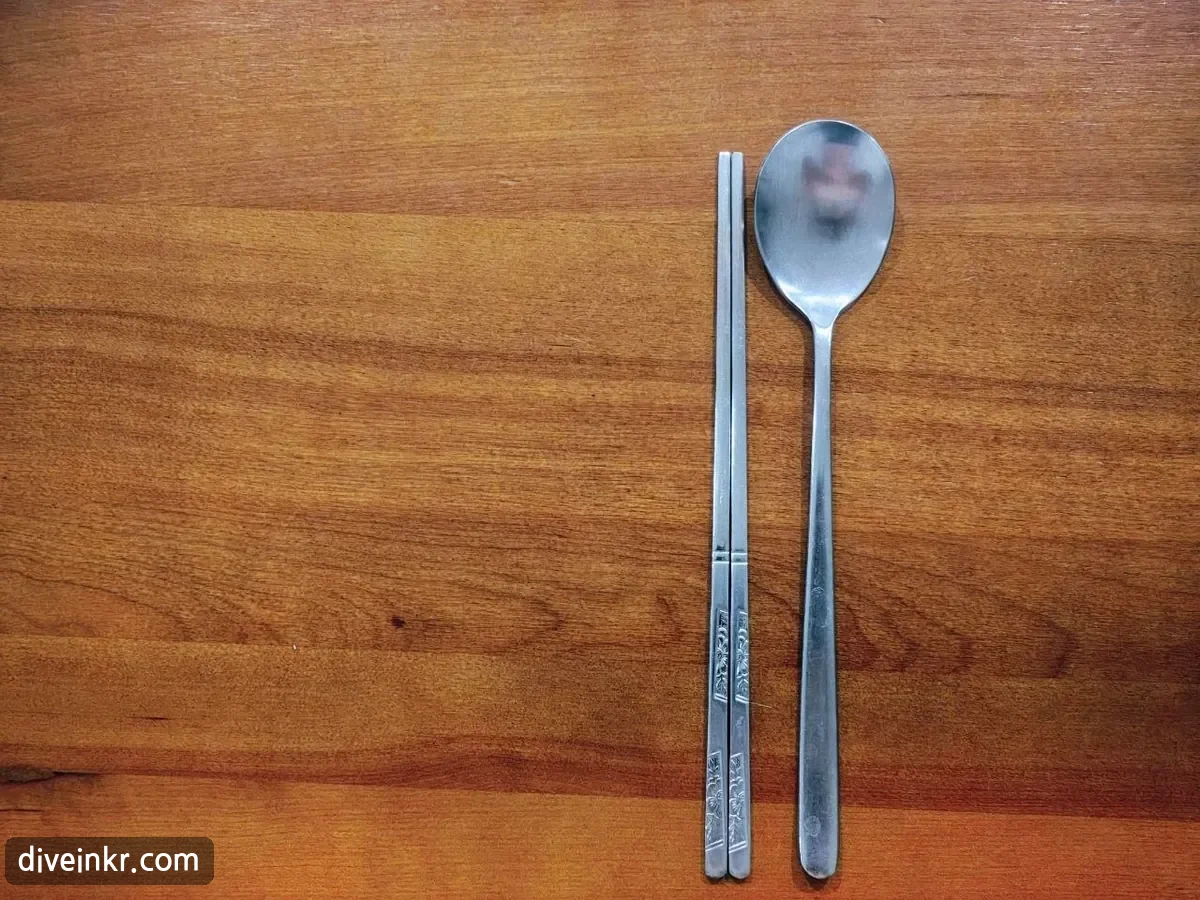
The 숟가락 (spoon) handles rice and soup; the 젓가락 (chopsticks) handle everything solid. Using both hands at once — spoon in one, chopsticks in the other — is considered poor manners; you set one down before picking up the other.
Age at the Table
Just like with 반말/존댓말, age quietly organizes the meal: the eldest is served first, often starts eating first, and younger people may pour drinks, portion food, or grill meat at a Korean BBQ table as a small act of care — connected to the same 선배/후배 and 오빠/형/누나/언니 logic covered elsewhere on this site.
Common Mistakes
Mistake #1 — Sticking chopsticks upright in your rice
This resembles incense sticks at an ancestral memorial table — avoid it even briefly while chatting.
Mistake #2 — Starting before the eldest person
A small pause at the start of a meal to let the eldest begin first is a quick, easy way to show you understand the culture.
Before the meal comes the doorway: why Koreans take off their shoes indoors.
Mini Quiz
2. How are 반찬 (side dishes) typically eaten?
3. What's the polite timing at the start of a meal with elders present?
Related Knowledge
Learn Next
Why Do Koreans Take Off Their Shoes?
Another everyday custom with real logic behind it — the shoes-off rule follows you from the table to the front door.
Will you remember this tomorrow?
Save it — your daily review brings it back right before you'd forget. No account needed.