Korean Name Structure Explained
Written and reviewed by Jun and Jin, native Korean speakers
Published · Updated · How we write & review
After this page, you can read a Korean name surname-first and address someone by name without sounding rude.
10-second answer
The short answer
Korean names put the family name (surname) FIRST, followed by the given name — 김민수 (Kim Minsu) means the surname is 김 (Kim) and the given name is 민수 (Minsu), not the other way around. Given names are usually two syllables, often chosen to carry a meaning, sometimes shared with siblings via a generational syllable.
Quick check — did that land?
1. In 박지민 (Park Jimin), what is the surname?
The Order: Surname First
| Name | Surname | Given name |
|---|---|---|
| 김민수 (Kim Minsu) | 김 (Kim) | 민수 (Minsu) |
| 박지민 (Park Jimin) | 박 (Park) | 지민 (Jimin) |
| 이수진 (Lee Sujin) | 이 (Lee) | 수진 (Sujin) |

When Koreans introduce themselves in English, they often flip the order to match Western convention ("Minsu Kim") — but on Korean ID cards, official documents, and in Korean speech, surname always comes first.
Want to see your own name written this way? The Korean Name Converter gives a sound-based Hangul version of an English name.
See also: How Korean Honorifics Work
Given Names Are Usually Two Syllables
Most Korean given names are built from two syllables, each often carrying its own meaning (traditionally from Chinese characters, 한자). 민수, for example, could combine characters meaning something like "clever" and "excellent" — parents historically chose characters for meaning and sound together.
One of the two syllables is sometimes a 돌림자 (dollimja) — a generational name syllable shared by siblings or cousins of the same generation in a family, so 민수 and 민지 might be siblings sharing 민.
Questions English Speakers Ask Most
Do Koreans have middle names? No. 민수 is one given name, not a first name 민 plus a middle name 수 — the two syllables belong together. Western forms that split it into "first" and "middle" are mislabeling it, which is why you'll see the same person as Minsu Kim, Min-su Kim, and Min Su Kim on different documents.
Are Korean names hyphenated? Only in romanization, and only by choice. Gildong, Gil-dong, and Gil Dong are the same name; the hyphen just shows the syllable break. Korea's official Revised Romanization writes given names as one word but allows the hyphen, and passports issued in different decades follow different habits. In Hangul there's never a hyphen — it's simply 길동.
Are all Korean names three syllables? Almost all: one-syllable surname + two-syllable given name. One-syllable given names exist (준, 별), and three-syllable given names appear occasionally, usually pure-Korean words rather than hanja combinations. Four-syllable given names are essentially unheard of. The rare two-syllable surnames (남궁, 황보) are what make a name four syllables — see common surnames.
돌림자 (dollimja) — the generational syllable
Traditionally, everyone in one generation of a clan shares a syllable, and it sits in the same position — so cousins might be 민수, 민지, 민호. The next generation shares a different syllable, often in the other position. In many old clans the sequence of syllables follows the five-element cycle (wood → fire → earth → metal → water) across generations. It's fading in the city, but if two Koreans share a syllable in the same spot, they may be relatives of the same generation.
Addressing Someone by Name
Using someone's bare given name (without a title) is casual — reserved for close friends and people younger than you, tying directly into the 반말/존댓말 system covered elsewhere on this site. For anyone else, a title or honorific attaches: 민수 씨 (Minsu-ssi, polite-neutral), 김 선생님 (Teacher Kim), or a role title alone.
민수야, 어디야?
minsuya, eodiya?
Minsu, where are you?
Casual — close friend, name + 야 (vocative for vowel-ending/consonant-adjusted names).
민수 씨, 회의 시작할까요?
minsu ssi, hoeui sijakhalkkayo?
Minsu, shall we start the meeting?
Polite workplace register — name + 씨.
Asking Someone's Name: 이름 vs 성함
Knowing the structure is half the job; the other half is asking for a name without sounding blunt. Korean has two words for it: 이름 (ireum), the everyday word for a name, and 성함 (seongham), its honorific form — the Standard Korean Language Dictionary defines 성함 as the respectful word for 성명 (a full name). Which one you use depends on who you're asking, the same logic as 님 and 씨.
이름이 뭐예요?
ireumi mwoyeyo?
What's your name?
Polite but plain — fine with people your age or younger: classmates, a new coworker at your level.
성함이 어떻게 되세요?
seonghami eotteoke doeseyo?
May I ask your name?
Literally: How does your (honored) name go?
Honorific — for someone older, a customer, or anyone you'd address with 님. Staff at hotels and clinics ask it this way.
제 이름은 김민수예요.
je ireumeun kim minsu-yeyo.
My name is Kim Minsu.
Full name, surname first — the same order as on an ID card. 민수 ends in a vowel, so it takes 예요 (see the 요 ending).
In a formal introduction the ending becomes 입니다 — 김민수입니다 — as in the self-introduction phrases. And once someone tells you their name, don't switch to the bare given name: add 씨 or a title, as in the section above.
Common Mistakes
Mistake #1 — Calling someone by surname alone
'Mr. Kim' works in English; addressing someone as just 김 씨 in Korean can sound distant or even slightly blunt in many contexts — using the given name (with 씨) or a role title is more common.
Mistake #2 — Assuming the given name is one syllable
Most Korean given names are two syllables together (like 민수), not a single standalone syllable — though modern one-syllable given names do exist too.
Free Worksheet: Surnames, Name Order and Your Own Name
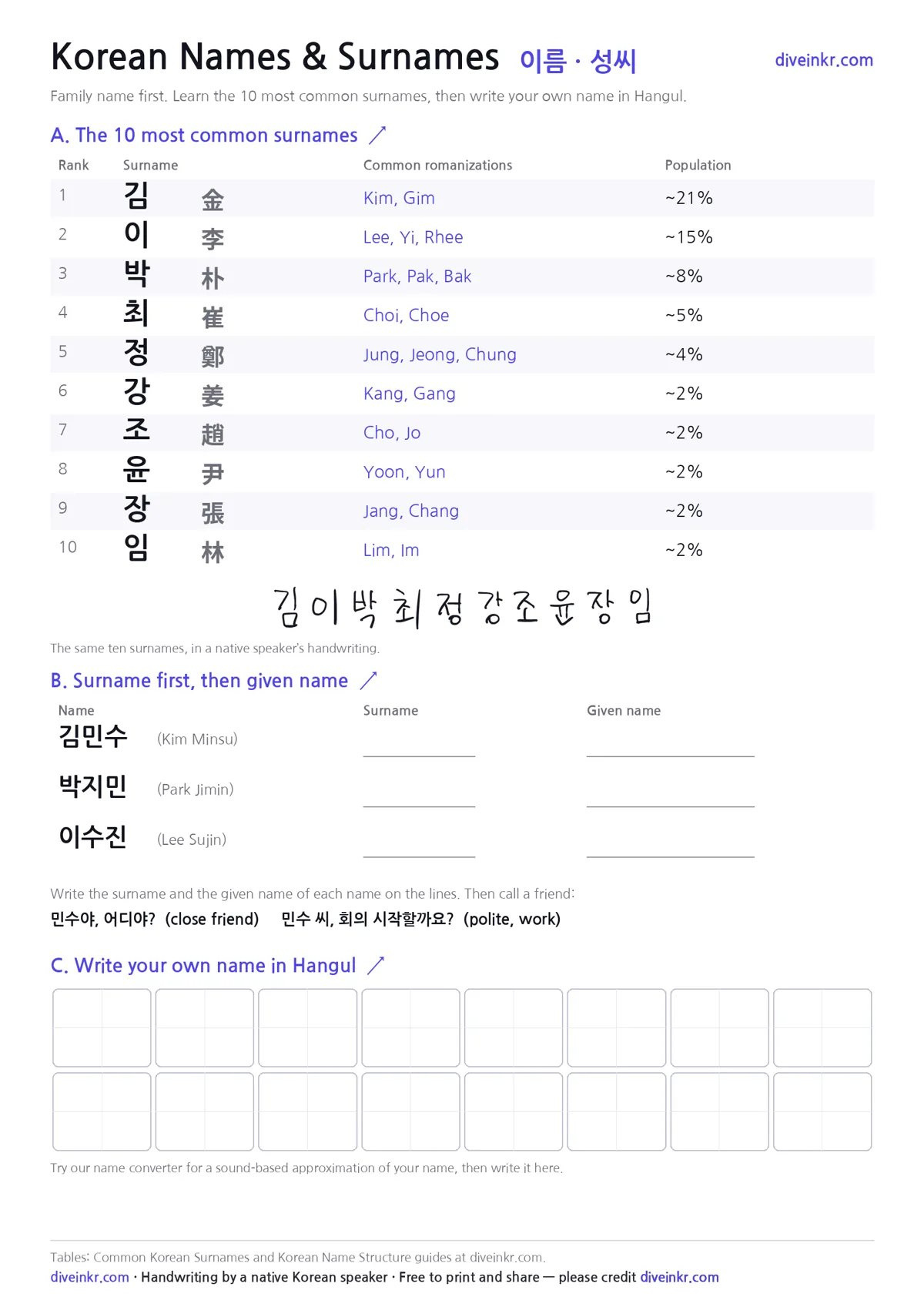
Free to print and share for personal and classroom use — please credit diveinkr.com.
- The ten most common surnames with their romanizations and population share, in print and in a native speaker's handwriting.
- A short exercise splitting 김민수, 박지민 and 이수진 into surname and given name — Korean puts the family name first.
- Writing boxes for your own name in Hangul; our name converter gives you a sound-based starting point.
Mini Quiz
2. What is a 돌림자 (dollimja)?
3. How should you generally address a Korean coworker's given name politely?
Related Knowledge
Learn Next
Common Korean Surnames Explained
You now know how names are structured — see why so many of them start with just a handful of surnames.
Will you remember this tomorrow?
Save it — your daily review brings it back right before you'd forget. No account needed.