Taxi Korean Phrases You'll Actually Need
Written and reviewed by Jun and Jin, native Korean speakers
Published · Updated · How we write & review
After this page, you can take a taxi in Korea — get one, give your destination and pay, all in Korean.
10-second answer
The short answer
Taxi Korean centers on one core move: naming your destination clearly, usually followed by 가 주세요 (ga juseyo, "please go [there]"). A handful of extra phrases — stopping, paying, and a polite way to address the driver — cover almost every situation you'll run into.
Quick check — did that land?
1. What's the respectful way to address a taxi driver?
Taking a taxi in Korea?
Full Dialogue Walkthrough
A basic ride, one with a mid-route change of plan, and a formal version for a longer trip. Use the "Practice as" toggle to hide your own lines and try saying them before revealing.
기사님, 안녕하세요.
gisanim, annyeonghaseyo.
Hello, driver.
여기로 가 주세요.
yeogiro ga juseyo.
Please go here.
Said while showing an address on your phone.
네, 알겠습니다.
ne, algetseumnida.
Okay, got it.
여기서 세워 주세요.
yeogiseo sewo juseyo.
Please stop here.
카드로 계산할게요.
kadeuro gyesanhalgeyo.
I'll pay by card.
죄송한데, 목적지를 바꿔도 될까요?
joesonghande, mokjeokjireul bakkwodo doelkkayo?
Sorry, could I change the destination?
-아/어도 될까요? — softly asking permission.
네, 어디로 가시겠어요?
ne, eodiro gasigesseoyo?
Sure, where would you like to go?
이 근처에 세워 주세요.
i geuncheo-e sewo juseyo.
Please pull over near here instead.
기사님, 공항까지 얼마나 걸려요?
gisanim, gonghangkkaji eolmana geollyeoyo?
Driver, how long does it take to the airport?
한 40분 정도 걸려요.
han saship-bun jeongdo geollyeoyo.
About 40 minutes or so.
네, 알겠습니다. 부탁드립니다.
ne, algetseumnida. butakdeurimnida.
Okay, understood. Thank you in advance.
부탁드립니다 — a formal, humble "please/thank you" for a favor being done.
감사합니다, 수고하세요.
gamsahamnida, sugohaseyo.
Thank you, take care.
See also: 아저씨 (ajusshi) — use with caution
Getting a Taxi: Street, Taxi Stand, or App
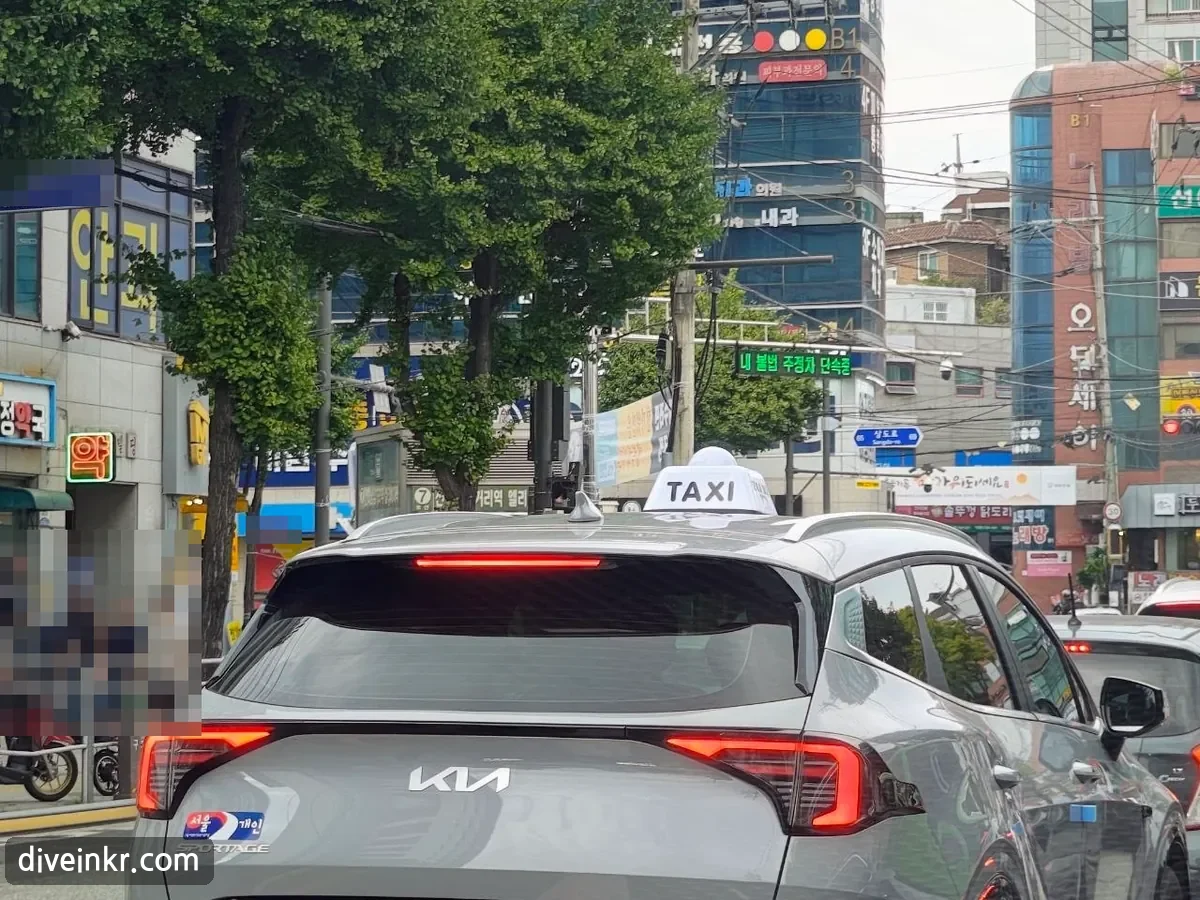
You can flag a taxi down on the street or wait at a taxi stand (택시 승강장), but more and more people call one with an app instead — Korean apps like Kakao T (카카오택시), or foreign ones like Uber.
For visitors, the app is the easy route. The payment method you set up in advance — usually a credit card — is charged automatically, and the driver already knows where you're going. The whole conversation can shrink to a greeting at the start and a thank-you at the end, which takes most of the pressure off if your Korean is still shaky.
Apps you can sign up for as a visitor
Kakao Mobility runs k.ride, a version of its taxi app for visitors: you can sign in with a Google, Apple or email account, register a foreign card, and use built-in translation. Uber also operates in Seoul through Uber Taxi. Set the app up before you need it, not at the curb.
About 기사님: it's the right word when you need to call the driver something, but you don't have to address the driver at all. Plenty of passengers just say 안녕하세요, give the destination, and say 감사합니다 on the way out.
| Seoul standard taxi (as of September 2026) | Fare |
|---|---|
| Base fare, first 1.6 km | 4,800 won |
| After that | +100 won per 131 m (or per 30 seconds in slow traffic) |
| Late night, 22:00–23:00 and 02:00–04:00 | +20% |
| Late night, 23:00–02:00 | +40% |
Fares are set by each city, so taxis outside Seoul differ slightly. On the bus instead? See how to ride a bus in Seoul.
If the formal thank-you feels stiff, 감사합니다 (kamsahamnida) explains when a lighter 고마워요 is fine.
Giving Your Destination
여기로 가 주세요.
yeogiro ga juseyo.
Please go here.
Said while showing an address on your phone — extremely common and reliable.
홍대입구역으로 가 주세요.
hongdaeipguyeogeuro ga juseyo.
Please take me to Hongik University Station.
이 근처에 세워 주세요.
i geuncheo-e sewo juseyo.
Please pull over near here.
Addressing the Driver
기사님 (gisanim, "driver" + honorific 님) is the standard, respectful way to address a taxi driver — far more natural than 아저씨, which that page covers as a riskier default.
기사님, 여기서 세워 주세요.
gisanim, yeogiseo sewo juseyo.
Driver, please stop here.
Paying and Wrapping Up
카드로 계산할게요.
kadeuro gyesanhalgeyo.
I'll pay by card.
얼마예요?
eolmayeyo?
How much is it?
Usually unnecessary — the meter and card reader handle it — but useful for cash payments.
감사합니다, 수고하세요.
gamsahamnida, sugohaseyo.
Thank you, take care.
수고하세요 — the present-tense form for someone still working, covered on the sugohaesseo page.
Common Mistakes
Mistake #1 — Defaulting to 아저씨 for the driver
기사님 is the standard, safer, more respectful address — see the ajusshi page for why 아저씨 carries more risk.
Mistake #2 — Overcomplicating the destination phrase
You don't need a full sentence — showing an address/map pin and saying 여기로 가 주세요 works perfectly and is extremely common, even among fluent speakers.
Mini Quiz
2. You want the driver to pull over near your current location. You say:
3. What's a natural way to give a destination while showing your phone's map?
Related Knowledge
Learn Next
You've arrived — now the phrases for the restaurant table itself.
Will you remember this tomorrow?
Save it — your daily review brings it back right before you'd forget. No account needed.