How to Ride a Bus in Seoul (and the Korean You'll Hear)
Written and reviewed by Jun and Jin, native Korean speakers
Published · Updated · How we write & review
After this page, you can ride a Seoul bus on your own — pay, transfer, get off at the right stop, and understand what the bus is telling you in Korean.
10-second answer
The short answer
Get a transit card (교통카드, gyotong kadeu) such as T-money at a convenience store, board at the front door and tap, press the stop button before your stop, and tap again as you get off at the back. Tapping off is what unlocks the automatic transfer discount to your next bus or subway within 30 minutes. Foreign credit cards can't be tapped on Seoul buses yet — that's planned for 2027.
Quick check — did that land?
1. You're getting off the bus. What should you do with your transit card?
교통카드! Tap when you get on, and don't forget to tap again when you get off.
Before You Board: Get a Transit Card
The simplest move is to buy a transit card and use it for every ride. Convenience stores sell them and top them up, so you're never far from one. Tapping a foreign-issued Visa or Mastercard straight onto a bus doesn't work yet. Korea knows this is one of the biggest headaches for visitors, and there's a plan to fix it — T-money has signed with the major card networks, and Seoul city buses are set to accept them first, in 2027 — but it isn't here yet.
| Option | Where to get it | Good to know |
|---|---|---|
| T-money card | Convenience stores (GS25, CU, 7-Eleven) and subway stations | Top it up with cash at the counter. Leftover balance can be refunded for a 500-won fee. |
| Climate Card tourist pass (기후동행카드 단기권) | Ticket machines in subway stations | Unlimited Seoul subway and Seoul buses for 1, 2, 3, 5 or 7 days (5,000–20,000 won, plus 3,000 won for the card). Red buses are not included. Since March 2026 the machines take foreign credit cards. |
| WOWPASS | WOWPASS kiosks | A prepaid card for visitors that doubles as a transit card; you can load it with foreign cash. |
Can I just pay cash?
On most Seoul buses you still can, but a growing number of routes are cashless, and paying cash means you lose the transfer discount. A card is simply easier.
See also: How to say bus and taxi in Korean
Reading the Bus: Colors and Fares
Seoul buses are color-coded by the kind of route they run, which tells you roughly how far they go before you read a single number.
| Color | Korean | What it does | Adult fare with a card |
|---|---|---|---|
| Blue | 간선버스 | Long trunk routes across the city | 1,500 won |
| Green | 지선버스 | Shorter routes that feed into subway stations | 1,500 won |
| Yellow | 순환버스 | Loops around the city center | 1,400 won |
| Red | 광역버스 | Express routes between Seoul and nearby Gyeonggi cities | 3,000 won |
| Small green | 마을버스 | Neighborhood buses for short hops (village buses) | 1,200 won |
Fares are Seoul's as of September 2026. The base fare covers the first 10 km; longer trips add 100 won per extra 5 km. Buses run by Gyeonggi Province cost a little more (1,650 won by card since October 2025).
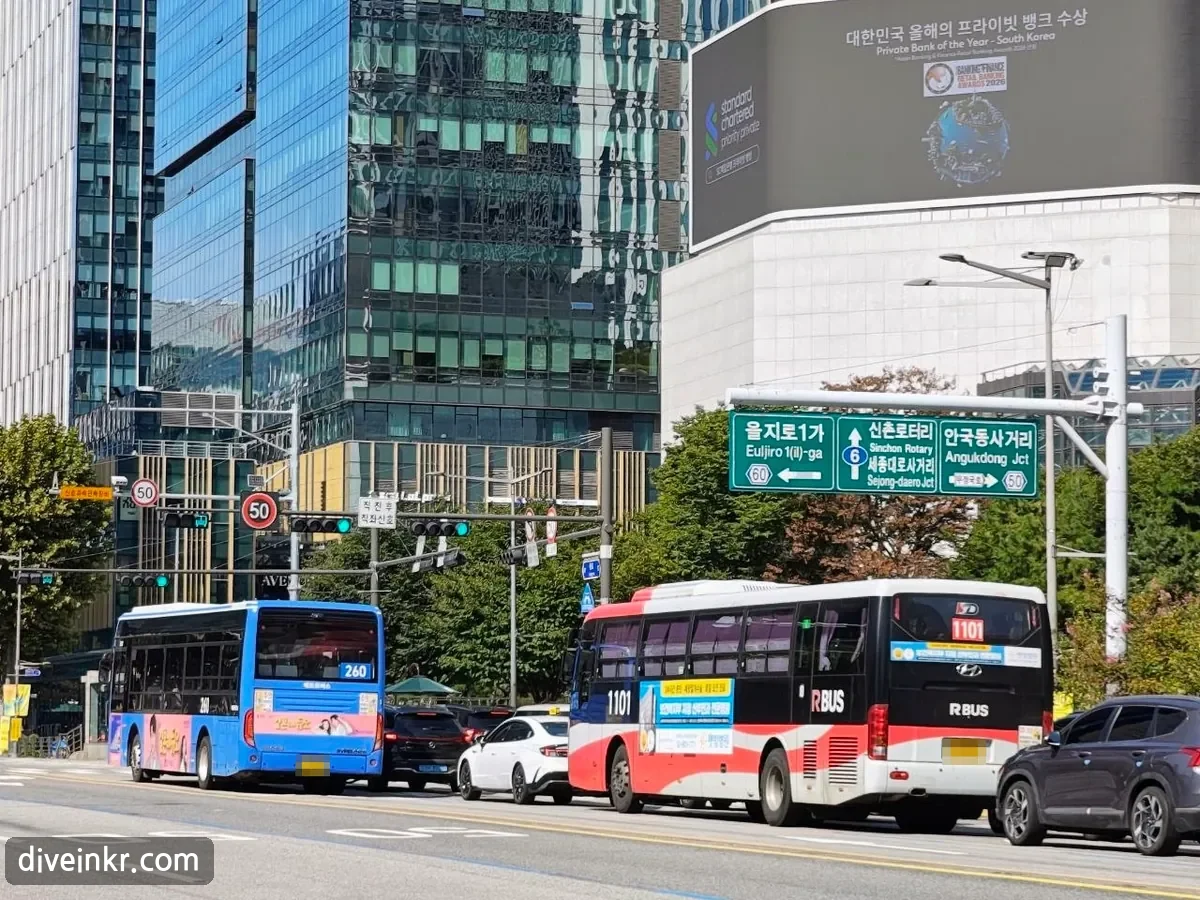
Red buses are the ones that cost about double, and there's a reason. They're commuter express routes between Seoul and the cities of Gyeonggi Province around it, so they cover long distances with few stops. A red bus run by Seoul costs 3,000 won by card; the red express buses run by Gyeonggi Province (직행좌석버스) went up to 3,200 won in October 2025. On very long trips, some routes add a small distance charge on top.
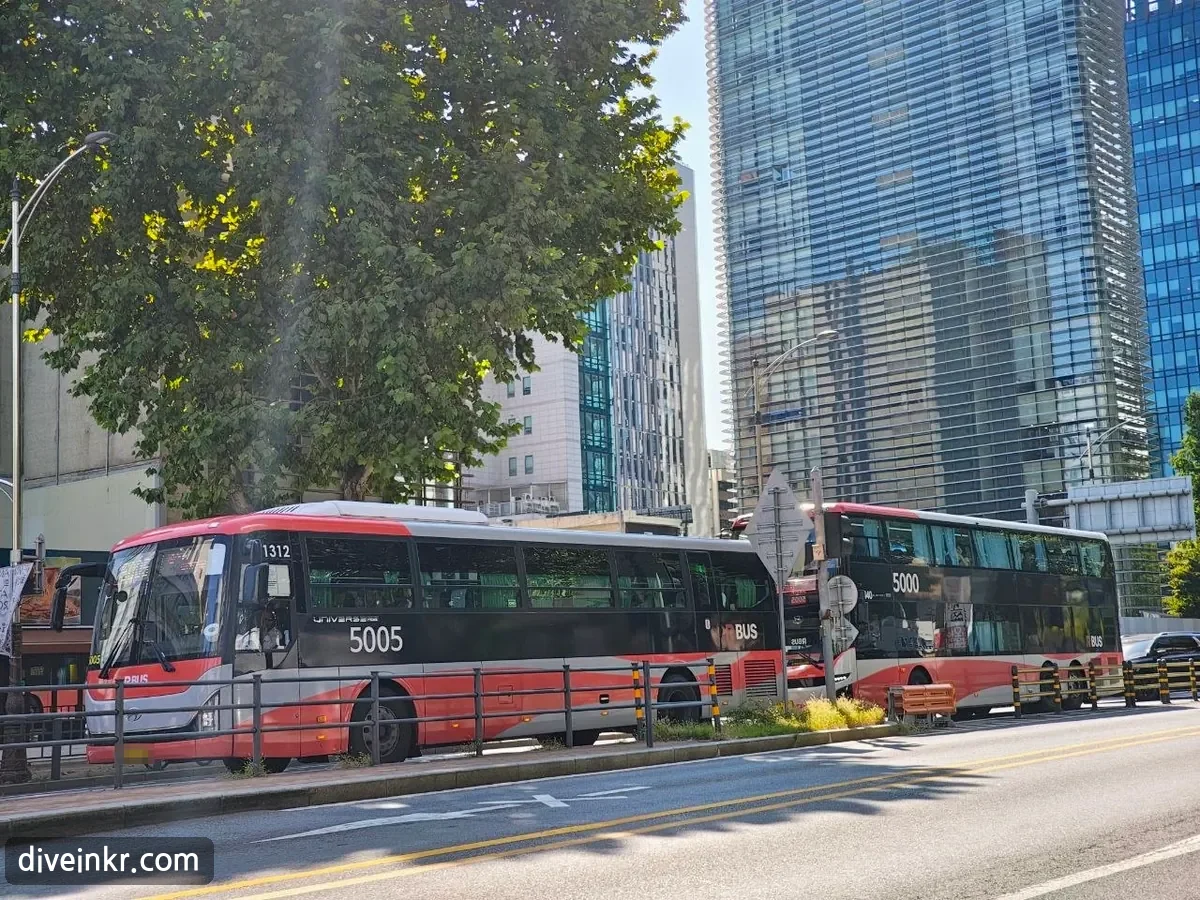
Two practical things follow from that. First, red buses use expressways, where Korean law requires every passenger to wear a seatbelt — so sit down and buckle up. Second, if you transfer between a regular bus and a red bus with a card, you're charged the higher of the two base fares, so a transfer onto a red bus costs you the difference rather than a whole new fare. And if you're out late, route numbers that start with N are late-night buses, 2,500 won by card.
At the Stop
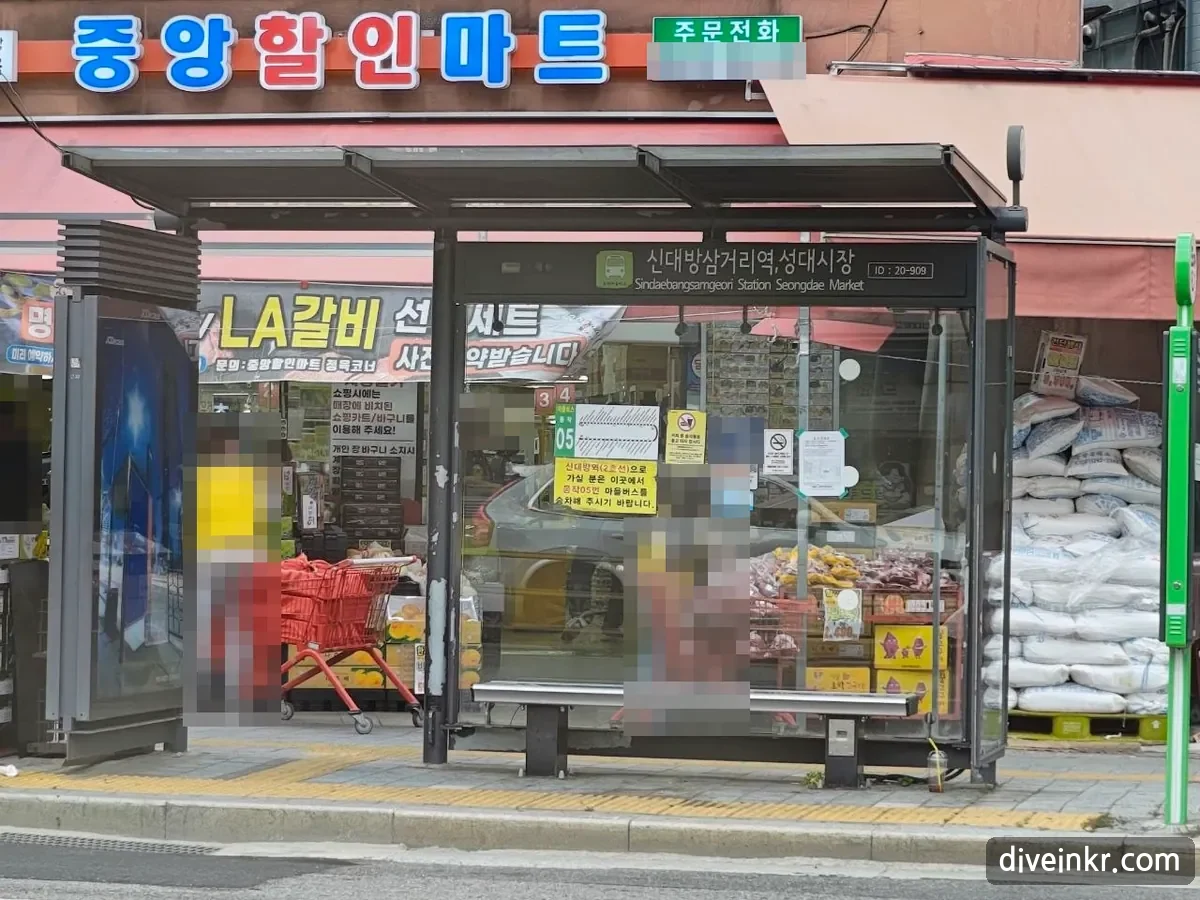
Stop names are usually a landmark or a subway station — here, a station and a market. For routes and live arrival times, people in Korea use KakaoMap or Naver Map; Google Maps is still limited in Korea. The apps show which bus to take, where to wait, and how many minutes away it is, so you rarely need to ask anyone. That's one reason a Korean SIM card or eSIM with data makes buses much less stressful.
The yellow notice in the photo tells people heading to Sindaebang Station on Line 2 which bus to catch here. It's a good example of the polite, slightly formal Korean you'll see on public signs (for shop signs, see reading Korean street signs):
신대방역(2호선)으로 가실 분은 이곳에서 동작05번 마을버스를 승차해 주시기 바랍니다.
sindaebangyeok(i-hoseon)euro gasil buneun igoseseo dongjak o-beon maeulbeoseureul seungchahae jusigi baramnida.
If you're going to Sindaebang Station (Line 2), please board the Dongjak 05 village bus here.
가실 분 = "people who will go" (honorific), 승차 = boarding, -아/어 주시기 바랍니다 = the formal "please…" of signs and announcements. Out loud, locals just say 마을버스 5번 (maeulbeoseu o-beon): village buses only run inside one neighborhood, so the district name 동작 gets dropped, and 05 is read as plain 오.
Downtown stops carry more information than the one above. Two things are worth learning to read: the dark sign on top of the shelter, and the colored route bands next to it.
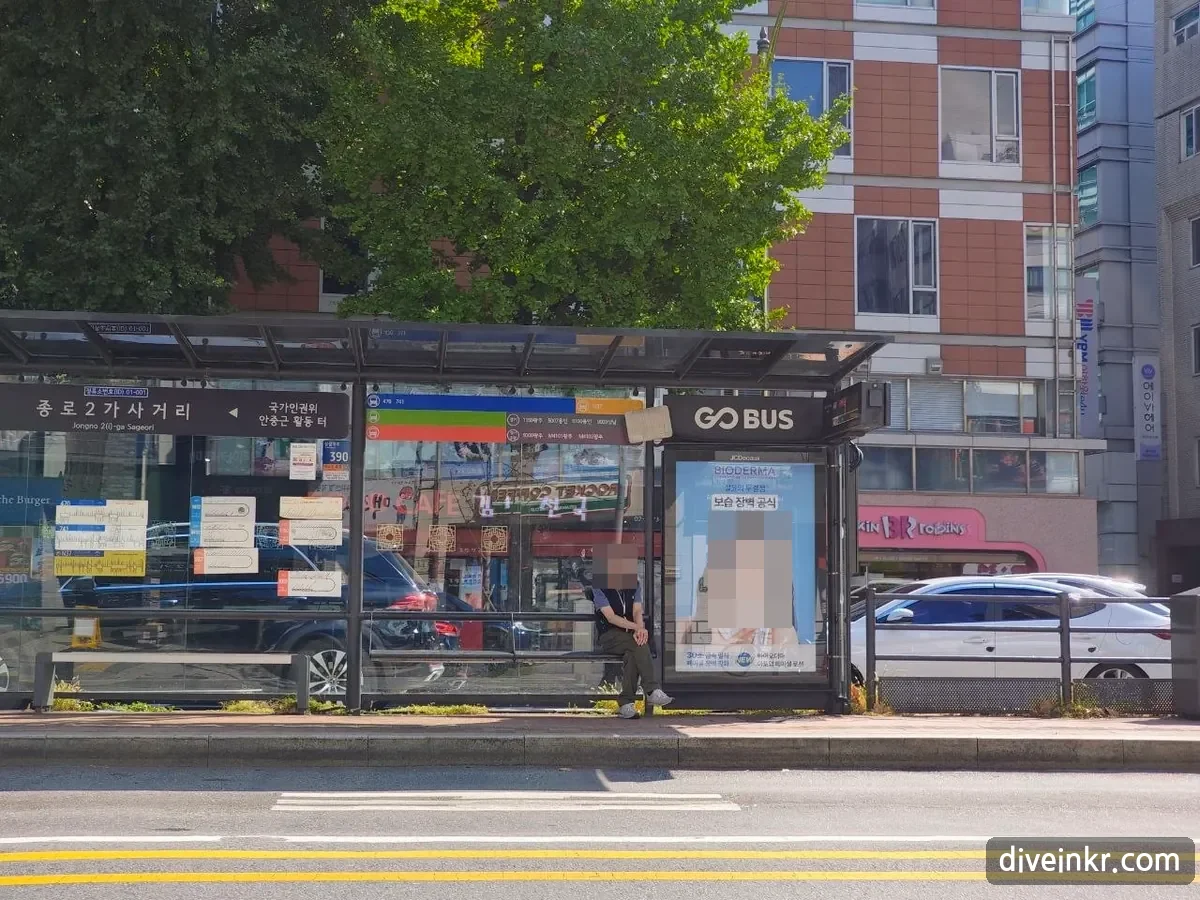
The dark sign works like a line on a map. The big name is the stop you're standing at. The smaller name after the arrow is the next stop in the direction the buses travel — here, ◀ 국가인권위 · 안중근 활동 터 (the National Human Rights Commission). A quick look tells you whether you're on the right side of the road before your bus arrives: if the next stop isn't the way you want to go, cross over.
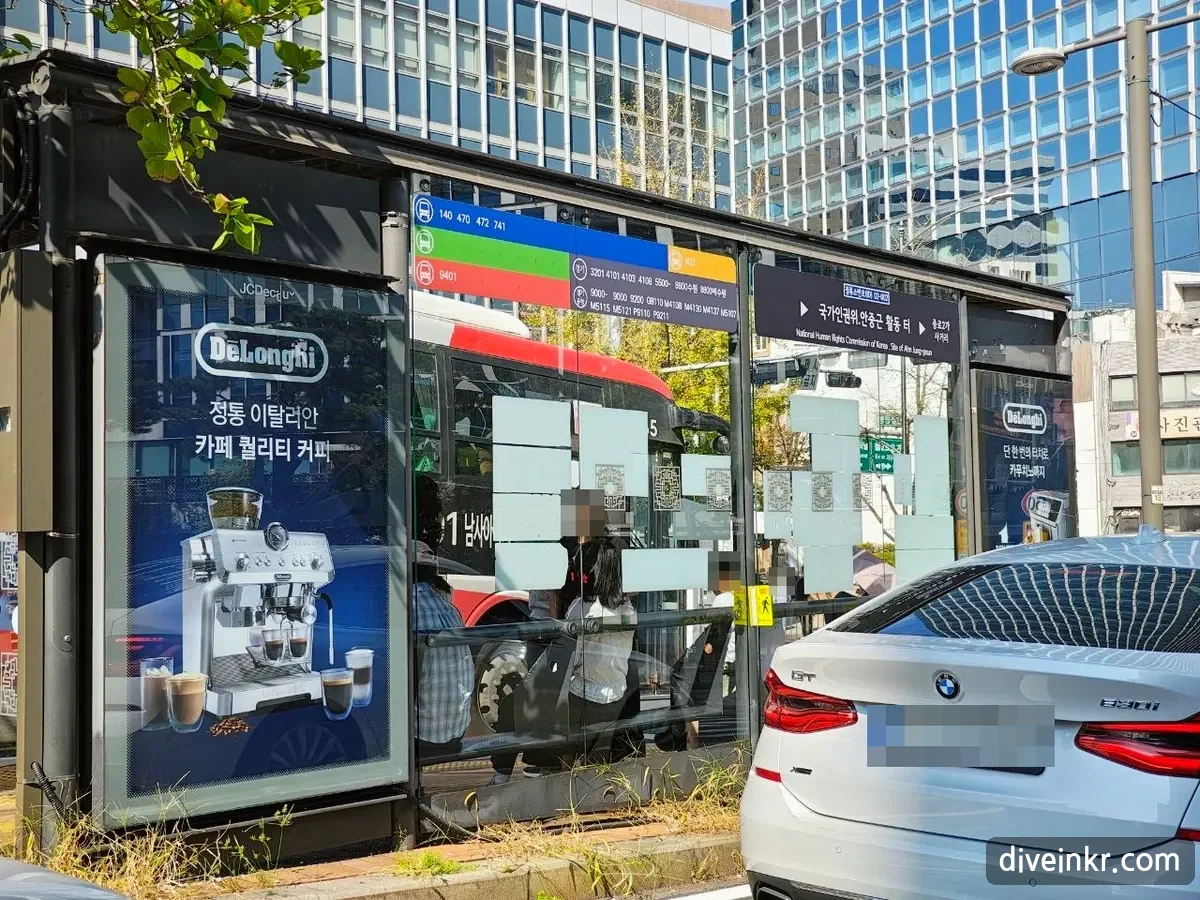
You'll meet 사거리 again and again, because many stops are named after the nearest big intersection. It's also the word locals use when giving directions: 다음 사거리에서 오른쪽으로 가세요 (daeum sageori-eseo oreunjjogeuro gaseyo) — "turn right at the next intersection." A three-way junction is 삼거리 (samgeori), from 삼 (three) instead of 사 (four).
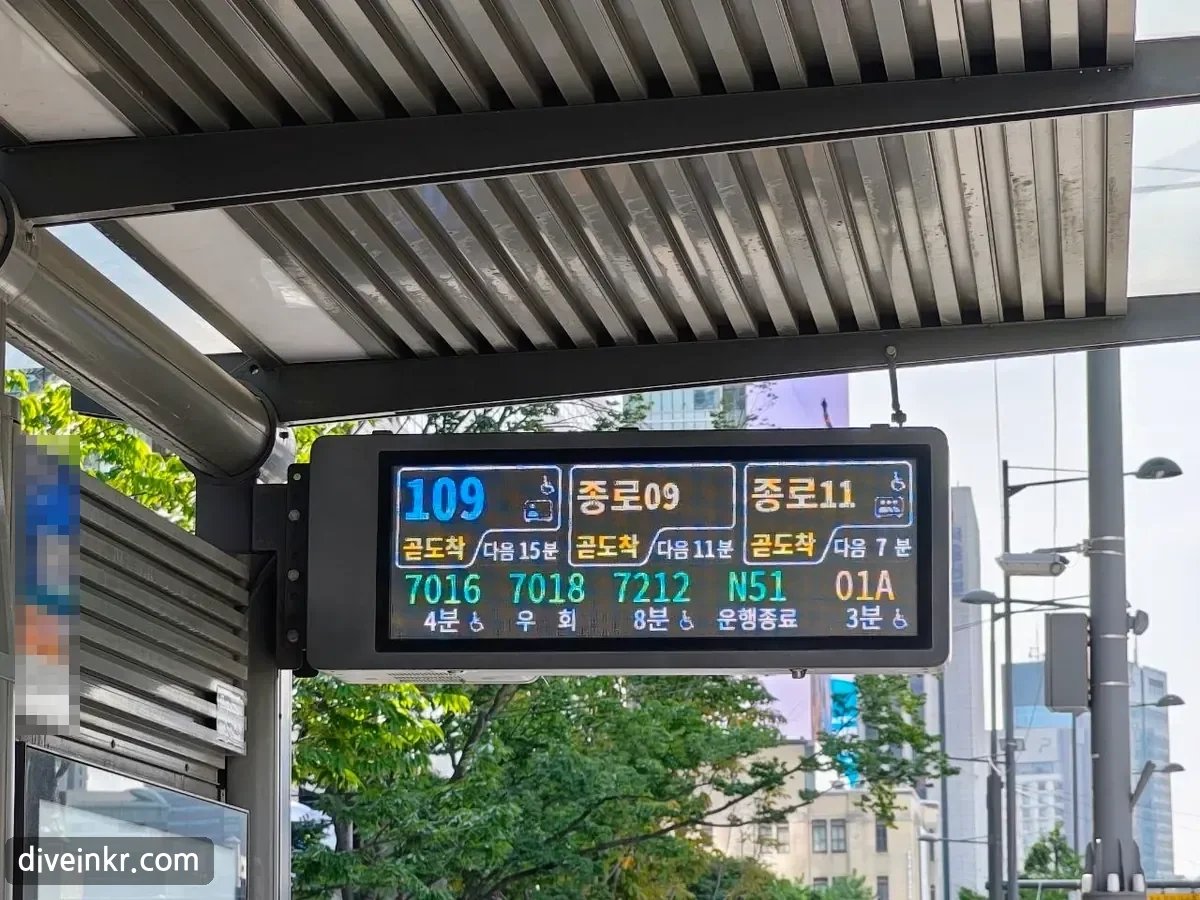
Many shelters in central Seoul have a live board like this, and it only uses a handful of words:
| On the board | Read as | Meaning |
|---|---|---|
| 곧도착 | got dochak | Arriving soon — get ready |
| 4분 | sa-bun | Arrives in 4 minutes |
| 다음 15분 | daeum sibo-bun | The bus after that comes in 15 minutes |
| 우회 | uhoe | Detour — the bus is taking a different route right now |
| 운행종료 | unhaeng jongnyo | Not running now — service is over (here, the late-night N51, which doesn't run in the daytime) |
| Wheelchair icon | A low-floor bus (저상버스) with no steps at the door — nearly three in four Seoul city buses are (73.7% in January 2026) |
Names like 종로09 and 종로11 are village buses (마을버스): the district name plus a number. Here 종로 means Jongno-gu, the district, not the street from the stop sign above. If your bus shows 우회, check the map app for where it will actually stop.
On the Bus: Tap On, Press the Button, Tap Off
- Board at the front door and tap your card on the reader next to the driver.
- Before your stop, press one of the stop buttons (하차 버튼) on the poles or walls. It lights up when pressed — so if it's already lit, someone else has pressed it and you don't need to.
- Get off at the back door, tapping your card on the reader there as you leave. Always tap off.
- The usual pattern is front door in, back door out. When the bus is packed at rush hour, people do get on and off through whichever door they can reach.
Seoul buses also don't allow open drinks: takeout cups with a drink or ice in them aren't allowed on board. A capped bottle is fine.
Transfers Are Automatic — If You Tap Off
Across Seoul, Gyeonggi and Incheon, buses and the subway share one fare system. You don't buy a transfer ticket; the card works it out. When you tap onto your next bus or train, the reader announces 환승입니다 ("transfer") and you pay little or nothing extra.
| Rule | Detail |
|---|---|
| Time limit | Board the next vehicle within 30 minutes of getting off (60 minutes between 21:00 and 07:00) |
| How many | Up to 4 transfers — 5 rides in one trip |
| What you pay | The trip is charged as one journey by total distance, so a transfer usually costs little or nothing extra |
| Doesn't count | Getting back on the same route, or paying cash |
Why tapping off matters
If you skip the tap when getting off, the card can't tell where your ride ended — the transfer chain breaks and you end up paying a fresh fare, sometimes more. It takes one second at the back door.
The Korean You'll Hear (and Say)
Most Seoul buses announce stops in Korean and then English. The card reader talks too, and those short lines are worth recognizing:
이번 정류장은 ○○입니다.
ibeon jeongnyujangeun ○○imnida.
This stop is ○○.
Your cue to get off — if you haven't pressed the button yet, press it now.
다음 정류장은 ○○입니다.
daeum jeongnyujangeun ○○imnida.
The next stop is ○○.
환승입니다.
hwanseungimnida.
Transfer.
The reader's voice when your discount kicks in.
카드를 한 장만 대 주세요.
kadeureul han jangman dae juseyo.
Please tap only one card.
You tapped a wallet with two transit-capable cards in it. Take one out.
이 버스 ○○ 가요?
i beoseu ○○ gayo?
Does this bus go to ○○?
You can ask the driver as you board, but these days hardly anyone needs to — people check the route in KakaoMap or Naver Map before they get on.
Bus and taxi are loanwords with a Korean twist in pronunciation — see how to say bus and taxi in Korean. If you're lost between stops, the phrases in asking for directions cover the rest, and for late nights there's always a taxi.
Bus colors are a good way to learn Korean color words: 파란 버스, 초록 버스.
Mini Quiz
2. The stop button is already lit when you reach for it. What does that mean?
3. Which Seoul bus color runs express routes between Seoul and nearby Gyeonggi cities?
4. The card reader says 환승입니다 when you board. What happened?
Related Knowledge
Learn Next
Taxi Korean Phrases You'll Actually Need
Buses stop running late at night — the taxi phrases are your backup plan.
Will you remember this tomorrow?
Save it — your daily review brings it back right before you'd forget. No account needed.