어 vs 오: The Vowel Sounds That Trip Up Learners
Written and reviewed by Jun and Jin, native Korean speakers
Published · Updated · How we write & review
After this page, you can hear and pronounce the difference between 어 (eo) and 오 (o) with minimal pairs and a simple lip trick.
10-second answer
The short answer
어 (eo) and 오 (o) are two completely different Korean vowel sounds that romanization makes look deceptively similar. 오 is a rounded "oh" sound, close to English "oh." 어 is unrounded and more open — closer to the "aw" in English "law" or the "u" in "cup," said with relaxed, unrounded lips.
Quick check — did that land?
1. What's the key difference in how 오 and 어 are pronounced?
You're saying 오빠 wrong.
Why Romanization Causes This Confusion
Standard romanization writes 오 as "o" and 어 as "eo" — reasonable as a written convention, but it doesn't tell your mouth what to actually do, and both can look like "just an o-sound" to an English-speaking eye. Reading Hangul directly instead of leaning on romanization is the fastest way past this specific trap.
| Letter | Romanization | Lip shape | Closest English sound |
|---|---|---|---|
| 오 | o | Rounded, pushed forward | "oh" as in "go" |
| 어 | eo | Relaxed, unrounded, open | "aw" as in "law" / "u" in "cup" |
See also: The Korean Alphabet (Hangul), Explained
Minimal Pairs You Can Hear the Difference In
오다 / 어다(x)
oda
to come
오 only — there's no real word 어다, but the syllable 오 vs 어 alone is the contrast to practice.
소 / 서
so / seo
cow / (a common syllable, e.g. in 저기서)
소 rounds the lips; 서 doesn't.
볼 / 벌
bol / beol
cheek / bee (or punishment)
A real minimal pair distinguished purely by 오 vs 어.
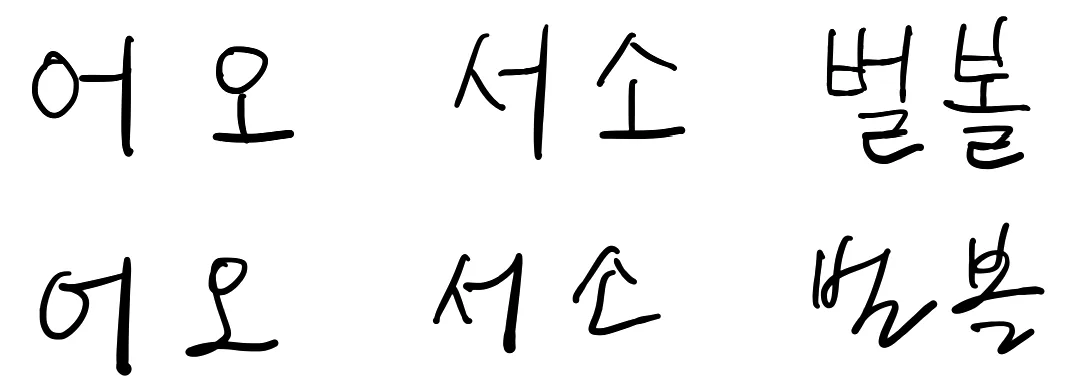
A Physical Trick
- For 오: round your lips like you're about to whistle, then say "oh"
- For 어: relax your lips completely — don't round them at all — and let the sound come from a more open, neutral mouth shape
- Say them back to back exaggeratedly (오-어-오-어) and feel your lips actively rounding and releasing
Why It Matters Beyond Just Sounding Natural
This pair shows up constantly in grammar you've already learned — 어요/아요 (present tense) partly depends on vowel quality, and words like 오빠 (oppa) vs a mispronounced "어빠" genuinely register as different, slightly odd-sounding words to native ears, not just an accent quirk.
Common Mistakes
Mistake #1 — Treating both as 'just an o sound'
They're distinct phonemes in Korean, not variants of the same sound — mixing them up can change or obscure the word.
Mistake #2 — Relying only on romanization to learn pronunciation
"Eo" doesn't intuitively signal "unrounded, open aw-sound" to an English reader — learning to read 어 directly as its own letter avoids the whole problem.
Free Worksheet: Read, Match and Trace
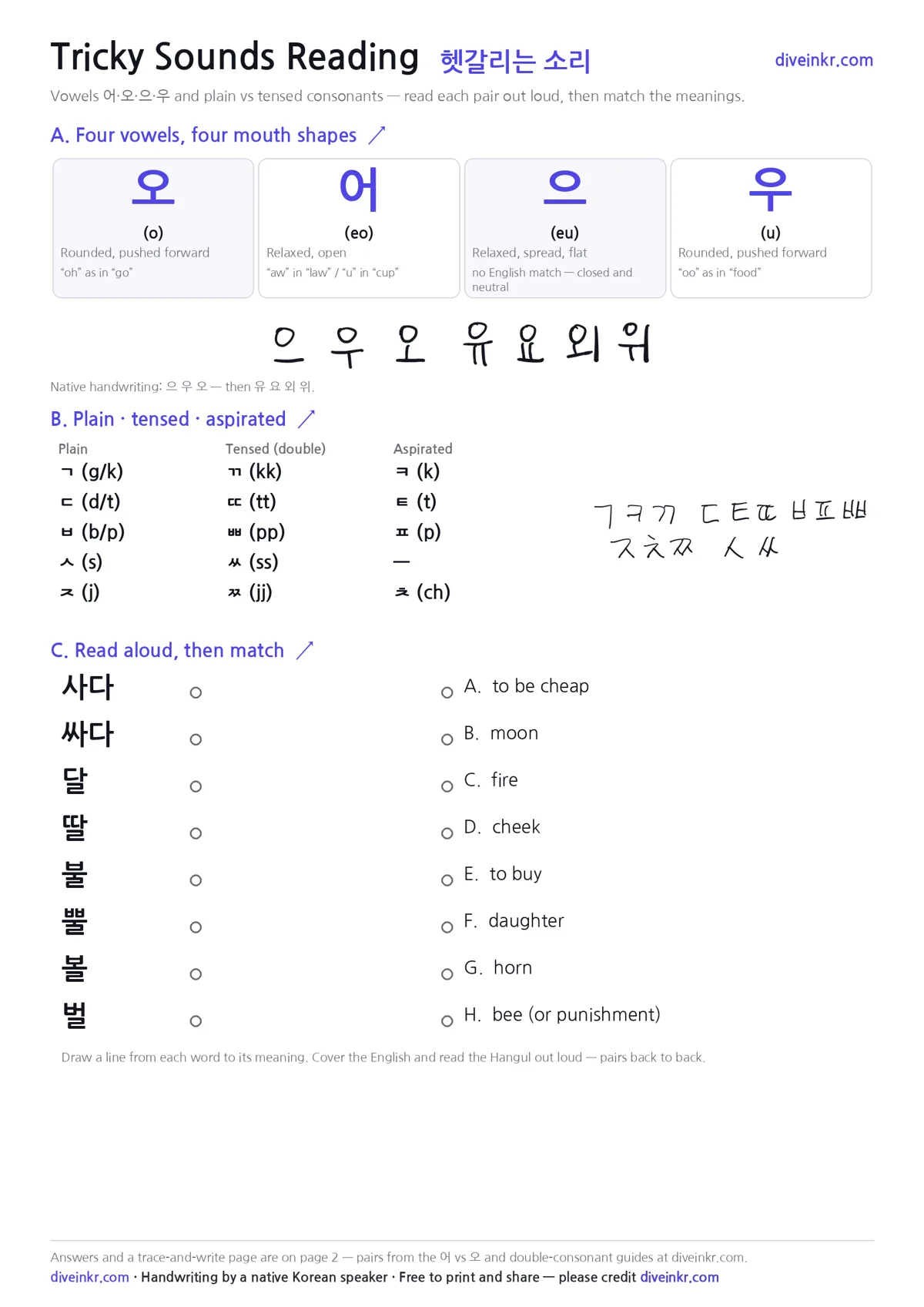
Free to print and share for personal and classroom use — please credit diveinkr.com.
- Page 1: the four vowels 오·어·으·우 with their mouth shapes, the plain / tensed / aspirated consonant table, and an 8-word matching game (사다 / 싸다, 달 / 딸, 불 / 뿔, 볼 / 벌).
- Page 2: the answers, plus trace-and-write rows for every word.
- Read each pair out loud, back to back, before you look at the English — the difference is in your mouth, not on the page.
Mini Quiz
2. Which English sound is closest to 어?
3. Why can relying only on romanization cause trouble here?
Related Knowledge
Learn Next
Another vowel with no real English equivalent — and one of the most distinctively Korean sounds you'll learn.
Will you remember this tomorrow?
Save it — your daily review brings it back right before you'd forget. No account needed.