The Korean Alphabet (Hangul), Explained
Written and reviewed by Jun and Jin, native Korean speakers
Published · Updated · How we write & review
After this page, you can read and recognize every letter of the Korean alphabet.
10-second answer
The short answer
한글 (Hangul) is the Korean alphabet — 14 consonants and 10 basic vowels that combine into syllable blocks. Unlike Chinese characters, it's a true alphabet: each letter represents one sound, and once you learn the shapes, you can sound out any Korean word, even ones you've never seen.
Quick check — did that land?
1. How does Hangul fundamentally work?
한글! Learn those pieces and you'll start reading unfamiliar words.
Not Characters — Letters That Combine
Hangul looks like blocky characters at a glance, which leads many beginners to assume it works like Chinese. It doesn't — each block is actually 2–4 individual letters (consonants and vowels) stacked together to form one syllable, the same way English letters combine into words, just arranged in a square instead of a line.
Those three letters stack into 한 (han) — one syllable block, three separate sounds.
See also: Korean double consonants (ㄲㄸㅃㅆㅉ)
The Basic Letters
| Type | Count | Examples |
|---|---|---|
| Basic consonants | 14 | ㄱ ㄴ ㄷ ㄹ ㅁ ㅂ ㅅ ㅇ ㅈ ㅊ ㅋ ㅌ ㅍ ㅎ |
| Basic vowels | 10 | ㅏ ㅑ ㅓ ㅕ ㅗ ㅛ ㅜ ㅠ ㅡ ㅣ |
| Double consonants | 5 | ㄲ ㄸ ㅃ ㅆ ㅉ (see the dedicated page) |
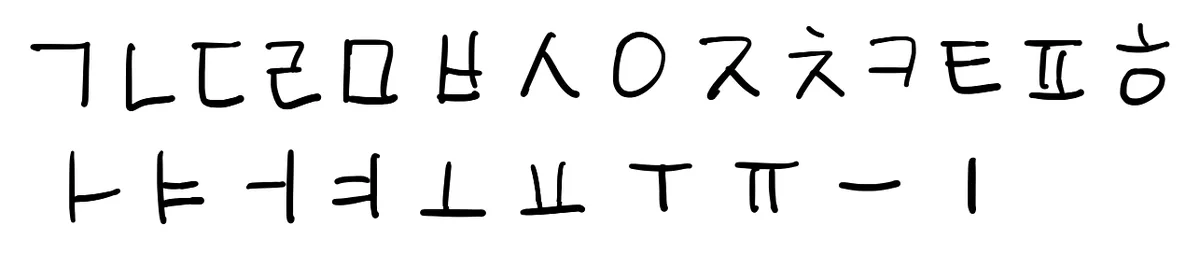
That's it for the core set — under 25 basic shapes generate the sounds of the entire language, which is a big part of why Hangul is famous for being fast to learn.
Once the shapes feel familiar, the Hangul Reading Practice quizzes letters and syllables until reading gets fast.
Want every letter in front of you while you study? Print the free Hangul chart — each letter in print and in a native speaker's handwriting.
Invented on Purpose, by a King
Hangul was created in 1443 under King Sejong the Great specifically to be easy to learn — before it, Korean was written using borrowed Chinese characters, which took years of study and were largely limited to the elite. Sejong's stated goal was that ordinary people could easily learn it and use it every day, and the scholar Jeong In-ji (정인지) wrote in the 1446 book that proclaimed it that a wise person could master it before the morning was over and even a slow learner within ten days. Hangul Day (한글날, October 9 in South Korea) marks that proclamation in 1446.
Consonant shapes weren't arbitrary either — several were designed to mimic the shape your mouth or tongue makes producing that sound. ㄱ (g/k), for example, is meant to echo the tongue touching the back of the mouth.
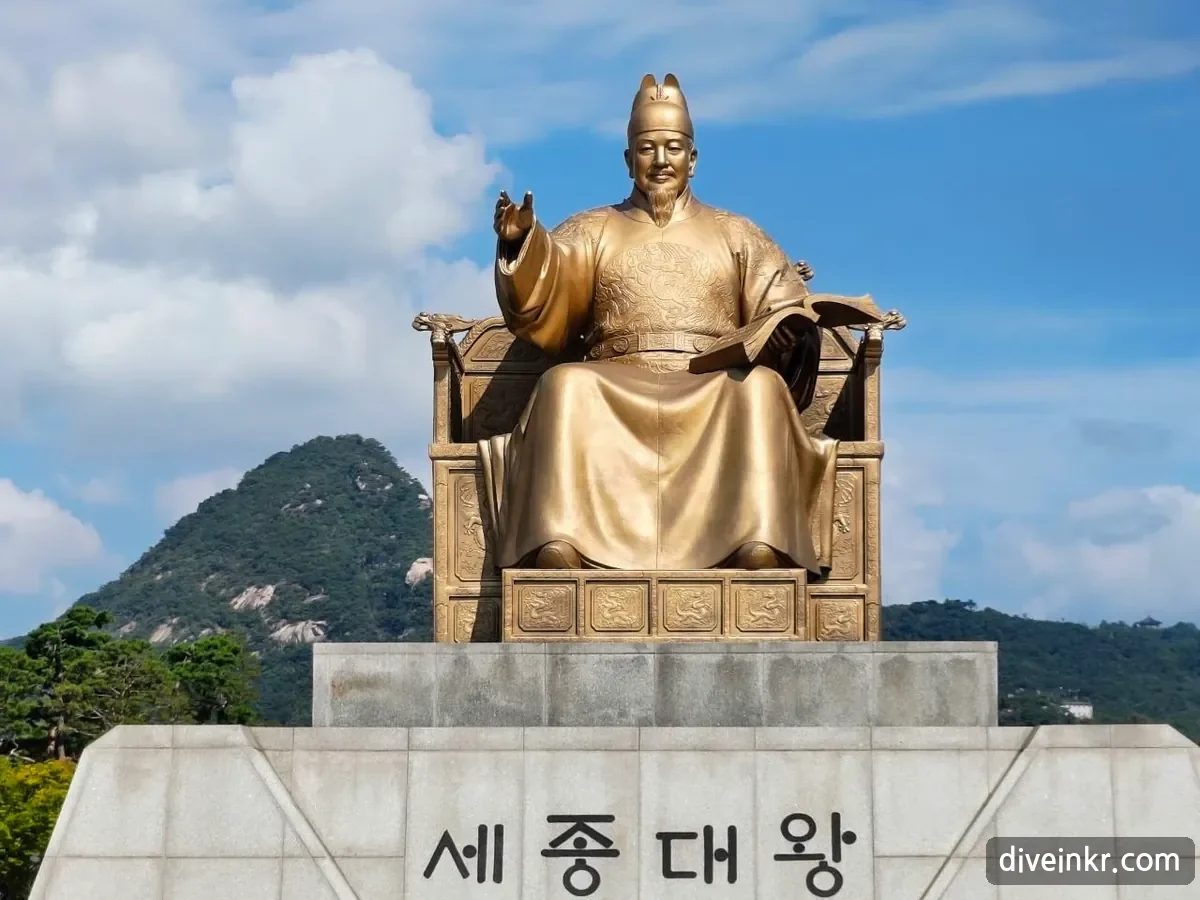
You can see King Sejong's statue, and copies of the inventions made in his reign, on a walk through Gwanghwamun Square in central Seoul.
한글날 (Hangul Day): October 9
Every year on October 9, Korea celebrates 한글날 (Hangul Day). It marks not 1443, when the letters were created, but 1446 — the year King Sejong proclaimed the new script under the name 훈민정음, "the correct sounds for teaching the people." The idea behind it was simple: ordinary people who couldn't read Chinese characters were at a disadvantage, and the new letters were meant to let anyone learn to read and write. In 2026, 한글날 falls on a Friday — see the table below for other years.
| Year | What happened |
|---|---|
| 1926 | Under Japanese colonial rule, the Korean Language Research Society declared the first 가갸날 ("Ga-gya Day") to protect the Korean language |
| 1928 | Renamed 한글날 |
| 1945 | The date was fixed as October 9, based on the original 훈민정음 document |
| 1946 | Made a public holiday (공휴일) under the U.S. military government's work rules |
| 1991 | No longer a public holiday (공휴일) — kept only as a commemorative day (decided in 1990) |
| 2005 | Made a 국경일 (national day) by law, but still not a day off |
| 2013 | A 공휴일 again (decided in 2012) — a day off, as it is today |
국경일 vs 공휴일
Two different things in Korean law. A 국경일 is a national day of celebration designated by law; a 공휴일 is an official day off, when government offices close — the "red days" on a Korean calendar. Korea has five 국경일: 3·1절, 제헌절 (Constitution Day), 광복절, 개천절 and 한글날. Today all five are also 공휴일 — 제헌절 was a working day from 2008 to 2025 and became a day off again in 2026.
| Year | October 9 falls on | Day off |
|---|---|---|
| 2025 | Thursday | Yes — the end of a seven-day break with 개천절 and Chuseok (October 3–9) |
| 2026 | Friday | Yes — a three-day weekend |
| 2027 | Saturday | Yes, plus a substitute day off on Monday, October 11 |
| 2028 | Monday | Yes — a three-day weekend |
| 2029 | Tuesday | Yes |
| 2030 | Wednesday | Yes |
In schools, the week around 한글날 usually brings writing contests (백일장), handwriting and calligraphy competitions, posters and quizzes on pure Korean words, and lessons on 우리말 바로 쓰기 — replacing loanwords, new slang and Japanese-style expressions with native Korean ones. For how handwriting differs from printed Hangul, see Korean handwriting vs fonts.
If you want to enjoy Korean the way Koreans do, try 우리말 겨루기 ("Korean Language Contest"), a long-running KBS quiz show that began in 2003. Contestants of all ages compete on spelling, vocabulary and correct usage, and the champions earn the title 우리말 달인 ("master of Korean"). Much of it is tricky even for native speakers — which is exactly what makes it fun — and it's a good listening challenge once you're past the basics.
Reading Order
Within a block, you read left-to-right and top-to-bottom, and blocks themselves read left-to-right (occasionally top-to-bottom in some formal/traditional layouts, but essentially always left-to-right in modern use).
감사합니다
gamsahamnida
Thank you
Five syllable blocks, read left to right: 감-사-합-니-다.
To feel how a block is built, try Hangul Typing Practice — you tap consonant, vowel, and batchim in order and watch the syllable assemble.
Common Mistakes
Mistake #1 — Trying to memorize whole words as pictures
That's how Chinese characters work, not Hangul. Learn the ~24 letters and their sounds, and you can already read words you've never seen.
Mistake #2 — Skipping straight to speaking without learning to read
Because Hangul is genuinely fast to pick up, most learners find it pays off quickly — romanization alone hides pronunciation details that Hangul makes clear.
Mini Quiz
2. Who is credited with creating Hangul, and when?
3. How many basic consonants and vowels does Hangul have?
Related Knowledge
Learn Next
You know the basic letters — batchim is the final piece that explains how syllable blocks can carry a third or fourth sound.
Will you remember this tomorrow?
Save it — your daily review brings it back right before you'd forget. No account needed.