Printable Hangul Chart with Native Handwriting (Free PDF)
Written and reviewed by Jun and Jin, native Korean speakers
Published · How we write & review
After this page, you can print a one-page Hangul chart and practice every basic letter in both printed and real handwritten form.
10-second answer
The short answer
This free, one-page PDF shows all 29 letters beginners need — 14 basic consonants, 5 double consonants and 10 basic vowels. Each letter appears twice: as a printed character, and as a native Korean speaker actually writes it by hand, with its romanization and Korean letter name underneath. Print it for your desk, your notebook or your classroom.
Quick check — did that land?
1. How many letters are on the chart in total?
한글 29개? Yes, this chart includes 14 basic consonants, 5 double consonants, and 10 vowels.
Download the Chart
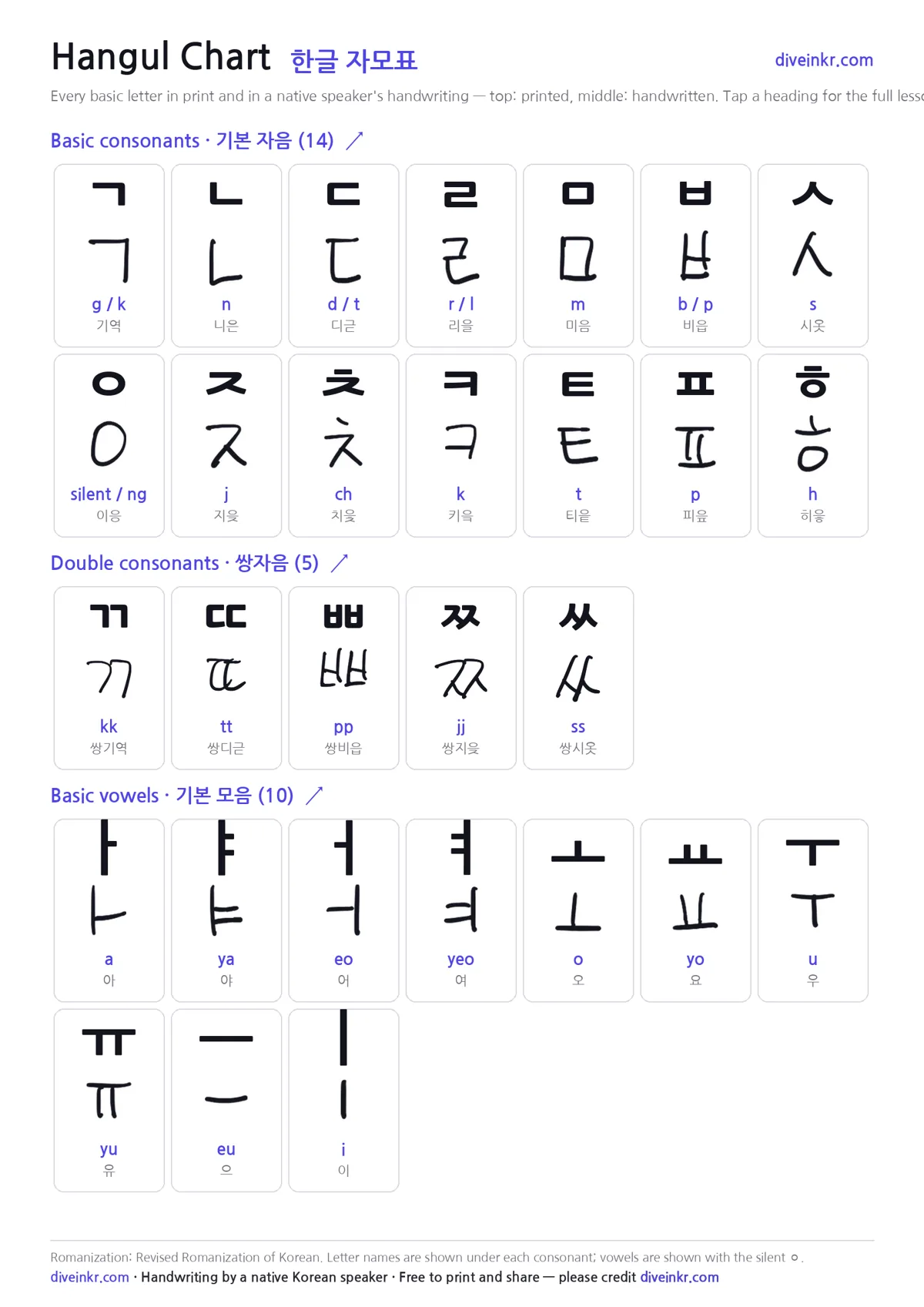
Free to print and share for personal and classroom use. It prints fine on US Letter too.
See also: The Korean alphabet, explained
Why Handwriting Next to Print?
Most Hangul charts show only a typeface. But the letters you'll see on a note, a whiteboard or a menu written by hand don't look exactly like a font — ㅊ, ㅎ and ㅈ in particular change shape when people write them. Seeing both side by side trains your eye for real Korean from day one. The page on Korean handwriting vs fonts shows more examples, including how the same letters look when written fast.
Every handwritten letter on this chart was written by a native Korean speaker from our team — the same handwriting you'll find throughout this site.
How to Use It
- Learn the 14 basic consonants and 10 vowels first — they're the whole system. The full explanation is on the Korean alphabet page.
- Add the 5 double consonants once the basics feel easy; they sound tenser, not just "doubled." See double consonants.
- Cover the printed row and read the handwritten one — then the other way round.
- Copy each letter by hand a few times, then quiz yourself with Hangul Reading Practice.
What's on the Chart
| Group | Letters | Shown with |
|---|---|---|
| Basic consonants (14) | ㄱ ㄴ ㄷ ㄹ ㅁ ㅂ ㅅ ㅇ ㅈ ㅊ ㅋ ㅌ ㅍ ㅎ | Romanization and letter name (기역, 니은, 디귿…) |
| Double consonants (5) | ㄲ ㄸ ㅃ ㅉ ㅆ | Romanization and letter name (쌍기역, 쌍디귿…) |
| Basic vowels (10) | ㅏ ㅑ ㅓ ㅕ ㅗ ㅛ ㅜ ㅠ ㅡ ㅣ | Romanization and the vowel written with the silent ㅇ (아, 야, 어…) |
Romanization follows the Revised Romanization of Korean, the official system used on road signs and in most textbooks. Some consonants have two values (ㄱ g/k, ㄷ d/t, ㅂ b/p, ㄹ r/l) because they sound different depending on where they fall in a word — more on that in the romanization guide.
Mini Quiz
2. Why is ㄱ romanized as both g and k?
3. What is the Korean name of the letter ㅅ?
Related Knowledge
Learn Next
See the same letters written quickly, the way Koreans write notes to each other.
Will you remember this tomorrow?
Save it — your daily review brings it back right before you'd forget. No account needed.