Korean Handwriting vs Fonts: Why Real Hangul Looks Different
Written and reviewed by Jun and Jin, native Korean speakers
Published · How we write & review
After this page, you can read everyday Korean handwriting and recognize the six letters that change shape when natives write fast.
10-second answer
The short answer
Korean handwriting follows the same letters as the fonts you learned, but when natives write fast a few letters change shape: ㄹ turns into something like a Z or a 2, the circle of ㅎ runs into a 6, ㅈ and ㅊ merge their strokes, and a final ㄴ or ㄹ sweeps out into a long tail. Learn about six of these changes and most everyday handwriting becomes readable. For your own writing, start with the neat form.
Quick check — did that land?
1. In fast Korean handwriting, which letter often looks like a Z or the number 2?
Six Letters That Change the Most
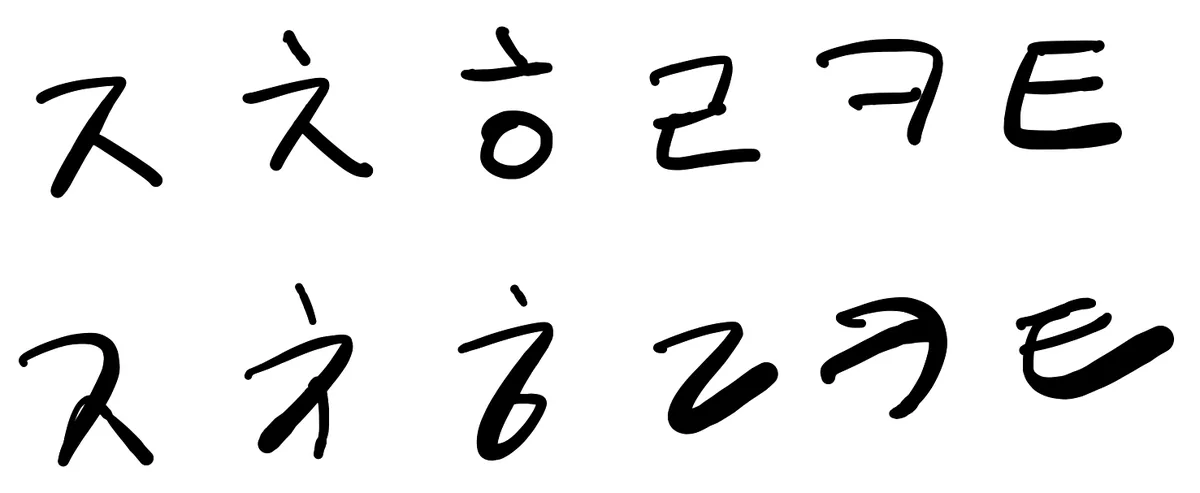
Below are six consonants handwritten by a native speaker. The top row is written neatly, stroke by stroke (또박또박). The bottom row is the same six letters written at normal everyday speed.
| Letter | Neat form (또박또박) | What happens when written fast |
|---|---|---|
| ㅈ (j) | Written neatly, stroke by stroke | The top stroke and the diagonal run together in one motion, and the two lower strokes cross |
| ㅊ (ch) | A short slanted tick on top | The part under the tick is written the same fast way as ㅈ |
| ㅎ (h) | Tick, bar, then a separate circle | The circle is drawn in one loop and can look like the number 6 |
| ㄹ (r/l) | Three separate turns | Written in one line, it looks like a Z or the number 2 |
| ㅋ (k) | Written neatly, stroke by stroke | The short middle stroke attaches low, so it can look like a 7 |
| ㅌ (t) | Shaped like a capital E | The bottom stroke stretches out into a long tail |
Notice what doesn't change: every letter still sits in the same place inside its syllable block. That's why a native reader never loses track, even when individual strokes get sloppy — the block structure from the Hangul basics does the heavy lifting.
See also: The Korean alphabet (Hangul), explained
The Same Words, Neat and Fast
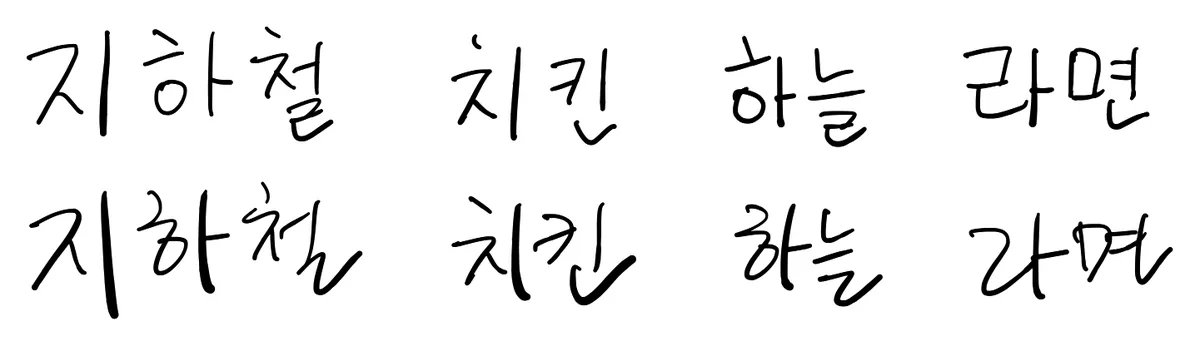
Letters change even more inside real words, because the hand moves straight from one letter into the next. Here are four everyday words, written carefully (top) and fast (bottom).
지하철
jihacheol
subway
In the fast version the final ㄹ of 철 turns into a long stroke that sweeps up and to the right.
치킨
chikin
chicken
The final ㄴ of 킨 ends in a big upward hook.
하늘
haneul
sky
The ㅡ and the final ㄹ of 늘 blur into one Z-like line with a tail.
라면
ramyeon
ramyeon (instant noodles)
The ㄹ of 라 is a single Z-shaped stroke, and the ㅁ of 면 rounds into a loop.
- A final consonant (batchim) such as ㄴ or ㄹ often ends in a long tail.
- ㄹ becomes a Z or 2 shape wherever it appears.
- ㅁ loses its corners and becomes a rounded loop.
- Long vertical strokes (the ㅣ in 지 and 치) stretch down below the rest of the word.
Should You Copy the Fast Version?
Not at first — and there's no need to rush. It works the same way in every language: once the basics are solid and your Korean gets stronger, advanced skills like writing fast, flowing handwriting and reading other people's quick handwriting come naturally. The fast shapes above are shortcuts that only work because the writer already knows the neat form by heart, so spend your time on the neat version first.
What is worth copying early is the proportion inside a block: vowels and consonants sharing the square, and the final consonant tucked underneath rather than floating off to the side. Getting that right makes even careful, slow handwriting look natural.
To build that sense of the block, drill reading with Hangul Reading Practice, and try assembling blocks letter by letter in Hangul Typing Practice.
To practice the neat version, print the Hangul chart with native handwriting and keep it next to your notebook.
Questions Learners Ask About Handwriting
"Can you check my handwriting?" is one of the most frequent posts on Korean-learning forums. These are the questions behind most of them.
- Does stroke order matter? Yes, mainly for speed and shape. Korean is written top to bottom and left to right inside each block; the fast forms above only come out naturally when that order is followed.
- My handwriting is neat and careful, not fast — is that a problem? No. Neatly written (또박또박) handwriting is completely readable, and it's exactly where you should be while you're learning. Speed comes later on its own.
- Why can't I read my Korean friend's handwriting? Usually because of the six letters above, especially ㄹ and final-consonant tails. Once you expect those shapes, most handwriting opens up. And if it still takes effort, that's normal — reading fast handwriting is one of the skills that grows with your overall Korean.
- Do I need to learn handwriting at all if I type? For reading signs, menus, and notes from Korean friends, recognizing handwriting helps a lot. Writing it yourself can wait.
Mini Quiz
2. What often happens to a final ㄴ or ㄹ when natives write fast?
3. What should a beginner learn first?
Related Knowledge
Learn Next
How Long Does It Take to Learn Hangul?
Now that handwriting makes sense, see how quickly the whole alphabet can click with a simple daily plan.
Will you remember this tomorrow?
Save it — your daily review brings it back right before you'd forget. No account needed.