Korean Family Tree Chart: What to Call Your Relatives (Free PDF)
Written and reviewed by Jun and Jin, native Korean speakers
Published · How we write & review
After this page, you can print a one-page Korean family tree and know what to call each close relative.
10-second answer
The short answer
This free PDF puts your closest Korean family terms on one page, with you in the middle: grandparents, parents, your parents' brothers and sisters on both sides, and your own siblings. Each box shows the word Koreans actually say (큰아빠 (keunappa), 이모 (imo), 외삼촌 (oesamchon)…), its romanization, and — in small print — the more formal term you'd see on a family chart.
Quick check — did that land?
1. What do you call your mother's sister?
Download the Chart
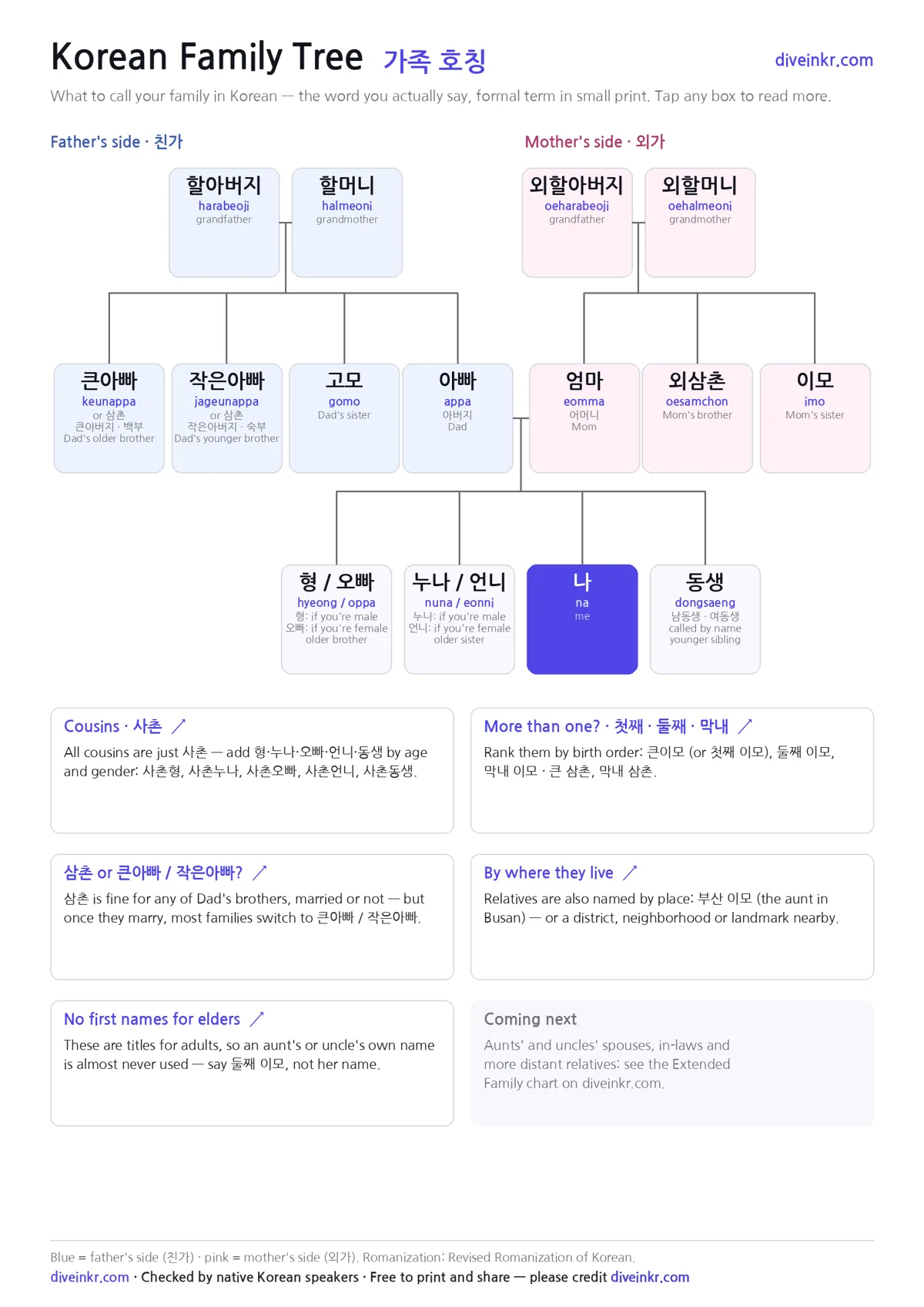
Free to print and share for personal and classroom use — please credit diveinkr.com.
See also: 이모 — Mom's sister
How to Use the Chart
- Print it on one A4 sheet (on US Letter, choose "fit to page") and keep it where you study.
- Cover the Korean, point at a box and say the word out loud — then read the Korean and say who it is in English.
- Pencil in your own family: next to 이모 or 고모, write which real relative that would be. Your own family sticks better than a stranger's.
- Keep the PDF on your phone too — every box except 나 links to that word's lesson.
Why Korean Needs a Chart for This
English gets by with "aunt," "uncle" and "cousin." Korean splits them by which parent they're related to and whether they're older or younger — so Dad's sister is 고모, Mom's sister is 이모, and Dad's older and younger brothers each have their own word. The full explanation is on Korean family titles beyond Mom and Dad.
- Blue boxes are Dad's side (친가, chinga), pink boxes are Mom's side (외가, oega) — the mother's side takes 외- (oe-): 외할머니, 외삼촌.
- Older siblings depend on your own gender too: a man says 형 and 누나, a woman says 오빠 and 언니. See 오빠 vs 형 and 언니 vs 누나.
Outside the family, the same words stretch to friends: see 오빠 (oppa) and 오빠 vs 형.
Walking Through the Tree, Row by Row
Top row — grandparents: 할아버지 (harabeoji) and 할머니 (halmeoni) on Dad's side, 외할아버지 (oeharabeoji) and 외할머니 (oehalmeoni) on Mom's. Talking about them calls for honorific Korean, like 댁 instead of 집 for "house."
주말에 할머니 댁에 가요.
Jumare halmeoni dage gayo.
I'm going to Grandma's this weekend.
댁 (daek) is the honorific word for someone's home — used for elders.
외할아버지는 올해 여든이세요.
Oeharabeojineun olhae yeodeuniseyo.
My grandfather on Mom's side is 80 this year.
여든 is native Korean for 80 — see native vs Sino-Korean numbers.
Middle row — parents and their siblings. Dad's side: 큰아빠 (his older brother), 작은아빠 (his younger brother) and 고모 (his sister). Mom's side: 외삼촌 (her brother) and 이모 (her sister) — Mom's brothers aren't split by age. Your parents are 엄마 and 아빠, with 어머니 and 아버지 in small print.
| What you say | More formal | Relationship term (rarely said to anyone's face) |
|---|---|---|
| 큰아빠 (keunappa) | 큰아버지 (keunabeoji) | 백부 (baekbu) |
| 작은아빠 (jageunappa) | 작은아버지 (jageunabeoji) | 숙부 (sukbu) |
| 엄마 / 아빠 (eomma / appa) | 어머니 / 아버지 (eomeoni / abeoji) | — |
고모가 세 분 계세요.
Gomoga se bun gyeseyo.
My dad has three sisters.
Literally: There are three (honored) 고모.
For elders, count with 분 (bun) instead of 명 and use 계세요 instead of 있어요.
Bottom row — you and your siblings. Older siblings get titles (형, 누나, 오빠, 언니), and you actually call them by those titles, not by name. A younger sibling is 동생 — 남동생 for a brother, 여동생 for a sister — but you call them by their name.
저는 오빠가 한 명 있어요.
Jeoneun oppaga han myeong isseoyo.
I have one older brother.
Said by a woman. A man would say 형이 한 명 있어요.
What the Chart Doesn't Say Out Loud
All cousins are simply 사촌 (sachon). Relationship terms for cousins on each side exist, but people don't use them in everyday conversation. Instead, Koreans add the sibling words by age and gender: 사촌형, 사촌누나, 사촌오빠, 사촌언니, 사촌동생. An older cousin is called 형, 누나, 오빠 or 언니 — sometimes with their name in front, like 지민 언니 — and a cousin your age or younger by name. See 사촌.
Cousins used to be plentiful, because families had many children. Today most households have one or two children, and many married couples choose not to have children at all — so many young Koreans have only a handful of cousins.
삼촌 or 큰아빠?
삼촌 works for any of Dad's brothers, and it doesn't sound odd even after an uncle marries. But once an uncle marries, most families switch to 큰아빠 or 작은아빠 — more on 삼촌.
Marriage adds a whole new set of titles — see our free Korean in-law titles chart.
Each sibling word has its own page: 언니 (eonni), 누나 (nuna), 오빠 (oppa) and 형 (hyeong).
Native-Speaker Notes: How Families Really Use These Words
- No first names for elders. 이모, 고모, 큰아빠 and the rest are titles for adults, so an aunt's or uncle's own name is almost never part of what you call them.
- More than one? Rank by birth order: 첫째 이모 or 큰이모 for the oldest, then 둘째 이모, 셋째 이모 — and the youngest is 막내 이모. It works for uncles too: 큰 삼촌, 둘째 삼촌, 막내 삼촌. The same goes for Mom's brothers: 큰 외삼촌, 막내 외삼촌.
- By where they live. Relatives are also named by place — 부산 이모 is the aunt who lives in Busan. Families use a district, a neighborhood or a well-known landmark nearby the same way.
- Mom and Dad grow up with you. 엄마 and 아빠 are what children say; many people switch to 어머니 and 아버지 as they get older, but plenty of adults keep saying 엄마 and 아빠.
부산 이모가 오셨어요.
Busan imoga osyeosseoyo.
Our aunt from Busan is here.
Not on this chart: the spouses of aunts and uncles (큰엄마 is the wife of Dad's older brother, 작은엄마 the wife of his younger brother, and 이모부 and 고모부 are the husbands of 이모 and 고모), plus in-laws after marriage. Every wife of Mom's brothers is simply 외숙모.
The youngest child's title, 막내 (maknae), is used far beyond the family — in K-pop groups and at work.
Common Learner Mistakes
- Mixing up 이모 and 고모. Tie them to the parent: 고모 is Dad's sister, 이모 is Mom's sister.
- Dropping 외- on Mom's side: her brother is 외삼촌, her parents are 외할아버지 and 외할머니.
- Using the side-specific cousin terms in conversation. Say 사촌 plus 형·누나·오빠·언니·동생.
- Picking the sibling word by the sibling's gender only. It depends on yours too: a woman's older brother is 오빠, a man's is 형.
- Calling an older sibling or cousin by first name alone. In Korean families, older means a title.
Mini Quiz
2. How do Koreans usually refer to a cousin in daily life?
3. A woman calls her older brother…
4. Your mom has three sisters. What do you call the youngest one?
Related Knowledge
Learn Next
Korean Family Titles Beyond Mom and Dad
The chart shows the words — this page explains the logic behind them, including birth-order rankings like 큰이모 and 막내 삼촌.
Will you remember this tomorrow?
Save it — your daily review brings it back right before you'd forget. No account needed.